Depression is not a rare condition. It is one of the most widespread mental health challenges in the United States, affecting tens of millions of people every year. Still, it goes undertreated for a significant portion of those who have it.
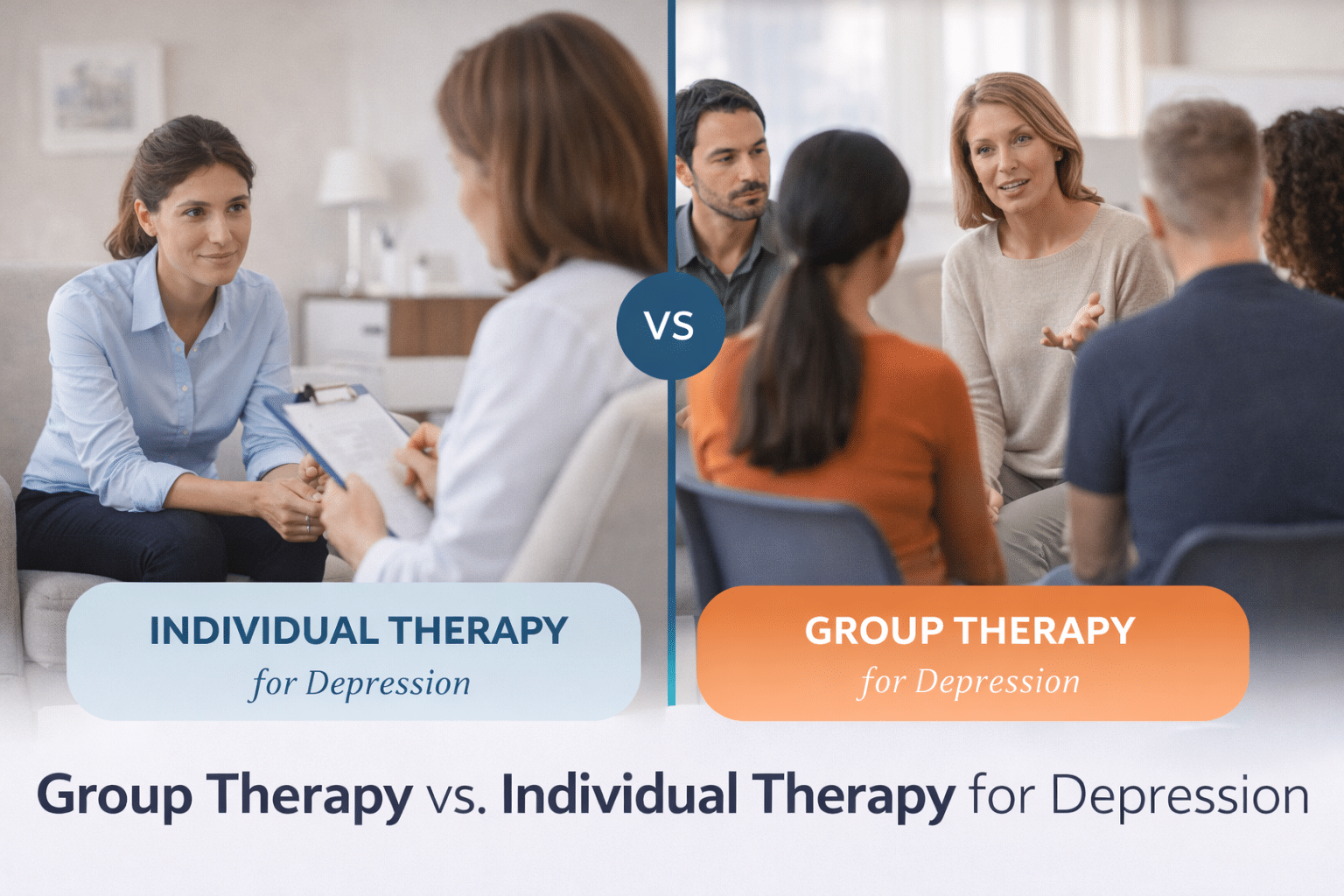
When someone finally decides to seek help, the next question is always: What kind of help? One-on-one therapy feels like the default. But group therapy for depression has a growing and genuinely strong evidence base.
So how do the two formats compare?
Quick Answer Summary
Both group therapy and individual therapy are effective treatments for depression, and research shows that long-term outcomes between the two formats are often comparable. Group therapy typically involves structured sessions led by trained clinicians where participants learn coping skills, share experiences, and build interpersonal support. Individual therapy allows for personalized attention and treatment pacing tailored to one person’s needs. While individual therapy may have a slight short-term advantage in some studies, group therapy offers unique benefits such as social connection, accountability, and cost efficiency. Many treatment plans combine both approaches to maximize recovery and support.
What Is Group Therapy for Depression, and How Does It Work?
Group therapy is a clinical modality, not a support circle. Group therapy typically involves 6 to 12 clients meeting regularly with one or two trained therapists. This structure aims to improve symptoms, build self-awareness, and develop coping skills together.
For depression specifically, most structured group therapy depression programs use cognitive-behavioral therapy (CBT) principles, transdiagnostic protocols, or interpersonal approaches. Sessions are facilitated, goal-directed, and clinically grounded. What makes them distinct isn’t just the number of people in the room.
A systematic review by Dingle and colleagues found that individuals who identified strongly with their group, who felt they were genuinely “in it together,” showed greater reductions in depression symptoms than those who didn’t. The mechanism is skill-building as well as belonging.
That piece is worth sitting with for a moment. Depression often involves profound isolation. A format that structurally interrupts that isolation, through regular shared experience with others who understand what you’re going through, is doing something that individual therapy doesn’t replicate in the same way.
What Does the Research Say About Effectiveness?
This is where people want a clear answer, and the data offers one, with some nuance.
A study by Paul and colleagues compared group and individual delivery of the same CBT-based protocol (the Unified Protocol for Transdiagnostic Treatment) in 127 outpatients at a specialized psychiatric hospital. Both formats produced significant improvements in depression and anxiety scores. There was no clinically meaningful difference in overall depression outcomes between the two groups at the end of 12 weeks. Group participants did show greater improvement in two interpersonal-focused domains of personal recovery, a finding that points to something the group format is adding, not just matching.
An older but still widely cited meta-analysis by Cuijpers and colleagues, the most direct head-to-head comparison available, covering 15 RCTs and 673 patients, did find that individual therapy had a small, statistically significant advantage at post-treatment (effect size 0.20). Worth noting. But that difference disappeared at one-to-three-month follow-up and at six-month follow-up, suggesting the gap closes over time.
Then there’s the Wong et al. systematic review and meta-analysis, which analyzed 33 RCTs of group therapy using group CBT for adults with clinical depression. The overall effect size for group CBT compared to inactive controls was 0.69, a solid, medium-to-large effect. Notably, the professional background of the therapist delivering group CBT was not a significant moderator. That finding has implications for scalability and access.
Together, what the research shows is that individual therapy may hold a small short-term edge, but group therapy for depression is demonstrably effective, and the difference largely evens out over time.
The Unique Benefits of Group Therapy
Group therapy isn’t just a more affordable version of individual therapy. It offers things that one-on-one sessions structurally cannot.
Hearing someone else articulate exactly how you’ve been feeling, and realizing it’s not just you, can shift something. That normalization happens organically in group settings and can be clinically significant for people whose depression involves shame, self-blame, or extreme isolation.
The Paul et al. study found that group participants showed greater improvement, specifically in interpersonal dimensions of recovery. That finding makes sense, given that group therapy inherently builds those interpersonal muscles.
There’s also the access and cost argument. Because group therapy is comparably effective to individual therapy, it has the potential to be more cost-effective and to widen access to psychotherapy for underserved populations. One therapist working with eight clients at once is simply a different economic model than one therapist working with one client at a time. For people navigating cost barriers or long waitlists, this matters.
The benefits of group therapy also extend to accountability and motivation. People show up differently when others are counting on them. That dynamic isn’t always present in individual sessions, and for some people, it’s exactly what’s needed.
When Individual Therapy May Be the Better Fit
Individual therapy remains the right starting point or the primary modality for many people, and the research supports that.
The Cuijpers meta-analysis found that individual therapy was associated with a lower dropout rate compared to group therapy (odds ratio 0.56). Dropout matters because therapy only works when someone stays in it. For people who are highly private, easily overwhelmed by social dynamics, or navigating acute or complex trauma, a group setting may create additional barriers rather than removing them. Some people simply need the undivided focus of a one-on-one relationship with a clinician before they’re ready or willing to engage in a group format.
Individual depression treatment also allows for a level of customization that is harder to replicate in a group. Pacing, disclosure depth, and therapeutic focus can all be adjusted in real time based on what one person needs that week. For someone in a more acute depressive episode, that responsiveness can be essential.
None of this means individual therapy is categorically superior. It means the fit depends on the person, that is, their current severity, their history, their comfort with vulnerability in social settings, and their treatment goals.
Can You Do Both?
For many people, the answer to “group or individual?” turns out to be “both.”
Someone might work individually with a therapist to process deeply personal material while simultaneously attending a structured group therapy program for depression that builds skills and peer connection. The two formats aren’t in competition.
In an integrated clinical setting, they can be sequenced or run in parallel depending on what the person needs at a given point in treatment. The benefits of group therapy don’t disappear because someone is also seeing an individual therapist, and the same is true in reverse.
Finding the Right Path Together
The question of group therapy vs. individual therapy doesn’t have a universal answer, and that’s actually useful information. It means there are real options, and that treatment can be shaped around what genuinely fits a person’s life, history, and goals.
At Zeam Health & Wellness, we offer both. Our group therapy programs and individual therapy services are part of the same integrated model of care, which means we’re not routing people into one format or another by default. We look at the full picture.
If you’re navigating depression treatment and wondering where to start, or if you’ve tried one approach and want to explore another, we’d welcome the conversation. Reach out to our team and let’s figure out what makes sense for you.
Key Takeaways
- Group therapy for depression typically involves 6–12 participants working with one or two trained clinicians using structured therapeutic approaches such as CBT.¹
- Research comparing group and individual therapy shows similar overall improvements in depression outcomes, with no meaningful difference after several months.²
- Individual therapy may have a small short-term advantage, but long-term outcomes between the two formats tend to converge.¹
- Group CBT demonstrates strong effectiveness compared to inactive controls, with medium-to-large treatment effects across multiple studies.³
- Group therapy offers unique benefits such as peer connection, normalization of experiences, and reduced isolation, which can be particularly helpful for depression.²
- Individual therapy may be preferable for people dealing with severe symptoms, trauma, or privacy concerns that make group settings difficult.¹
- Many treatment plans combine both individual and group therapy to provide both personalized support and social reinforcement.
Citations
- https://www.sciencedirect.com/science/article/abs/pii/S0165032720330597?via%3Dihub
- https://pmc.ncbi.nlm.nih.gov/articles/PMC10901779/
- https://www.ncbi.nlm.nih.gov/books/NBK74976/