
Most people who enter psychiatric treatment do so expecting things to get better. And for many, they do.
However, a meaningful share of patients reach a point where the medication has been adjusted, therapy is consistent, and the results still feel incomplete. The residual symptoms, such as a mood that won’t fully lift, attention that keeps slipping, or a mind that loops back on itself, don’t respond the way anyone hoped. That’s the space where neurofeedback therapy has started entering clinical conversations as an adjunct option.
This article explains when that happens, how clinicians approach it, and what patients can realistically expect.
Quick Answer Summary
Neurofeedback therapy is typically used as an adjunct treatment when traditional psychiatric care, like medication and therapy, does not fully resolve symptoms. It targets specific brain activity patterns related to issues like rumination, attention, and emotional regulation. While promising, it is considered an emerging option and is usually added alongside established treatments rather than replacing them.
Key Takeaways
- Many patients experience residual symptoms even after consistent psychiatric treatment¹
- Neurofeedback is introduced as an adjunct when standard treatments provide partial relief²
- Early research shows neurofeedback may reduce depressive rumination and improve attention³
- Evidence for ADHD shows modest but consistent improvements, though medication remains first-line⁴
- Neurofeedback for anxiety is still emerging and often targets shared brain networks⁵
- Major clinical guidelines consider neurofeedback an experimental or supplemental option, not a replacement for standard care⁶
Why Clinicians Look Beyond Traditional Care
Treatment helps a lot of people, but it doesn’t reach everyone the same way. The 2024 National Survey on Drug Use and Health found that 64.4% of U.S. adults with a past-year major depressive episode received some form of mental health treatment, which means clinicians are already engaging most people before adjunctive options come up. The gap isn’t purely about access. Even among those in active treatment, residual symptoms remain a real and common problem.
The ADHD picture shows a similar gap. A recent survey estimated that roughly 30% of children with current ADHD, about 1.9 million, received neither medication nor behavioral treatment that year. Of those who did receive care, 77.9% had at least one co-occurring condition, including about 4 in 10 with anxiety. That kind of clinical complexity is often what pushes the conversation toward additional layers of support.
How Neurofeedback Enters the Conversation
There are a few recognizable clinical moments when a provider might bring up neurofeedback therapy as an option. One is when depression has partially responded to medication or therapy, but rumination and self-referential thinking remain elevated.
Another is when anxiety and depression overlap in a way that psychotherapy alone hasn’t fully addressed, particularly when self-regulation is still poor. A third is when ADHD symptoms persist despite medication, or when families want a non-drug layer of care.
In each case, the pattern is the same: Standard care has done something, but not enough. Neurofeedback isn’t a swap. It gets added onto an existing plan to work on a specific unresolved target, like attention, rumination, or emotional regulation, that medication and talk therapy haven’t fully touched.
Neurofeedback for Depression
Of all the conditions in the current U.S. literature, neurofeedback for depression has some of the more striking recent findings, but it comes with real caveats.
A double-blind randomized controlled trial enrolled 43 depressed individuals and used real-time fMRI neurofeedback targeting brain networks linked to rumination. The active group showed a large reduction in brooding rumination scores, nearly double the threshold researchers use to define a “large” clinical effect. The sham group showed virtually none.
That’s a specific and useful finding. But the authors themselves noted that clinical efficacy remains underexplored. This isn’t evidence that neurofeedback resolves depression broadly; it’s an early signal that it may reduce what standard care often leaves behind.
Neurofeedback for ADHD
The most usable recent U.S. evidence for neurofeedback ADHD comes from a 2024 systematic review by the American Academy of Pediatrics, which analyzed 21 studies covering EEG-based protocols. Across 12 studies with nearly 1,000 participants, symptoms improved meaningfully, a modest but consistent effect that held even when the analysis was narrowed to randomized controlled trials only.
The AAP still rated the strength of evidence as low and affirmed that medication holds the stronger evidence base. But the review supports neurofeedback as a reasonable add-on when medication response is incomplete, or when families want to reduce reliance on pharmacological care alone.
Neurofeedback for Anxiety
For neurofeedback anxiety, dedicated U.S. evidence is still early and often bundled with depression in the same studies. An adolescent pilot enrolled 9 teens with a lifetime history of depression or anxiety and used mindfulness-based fMRI neurofeedback to target default mode network connectivity, the network associated with rumination and internalizing symptoms. All 9 showed reduced DMN connectivity after the session, and neurofeedback performance predicted changes in mindfulness state.
It was a proof-of-concept with no control group and a single session. The study still illustrates how the field is exploring neurofeedback as a transdiagnostic tool aimed at shared internalizing circuitry, not a disorder-specific anxiety protocol.
What Patients Can Expect When Neurofeedback Is Added
Adding neurofeedback to a care plan doesn’t replace therapy or medication. It adds a structured, active layer on top of them.
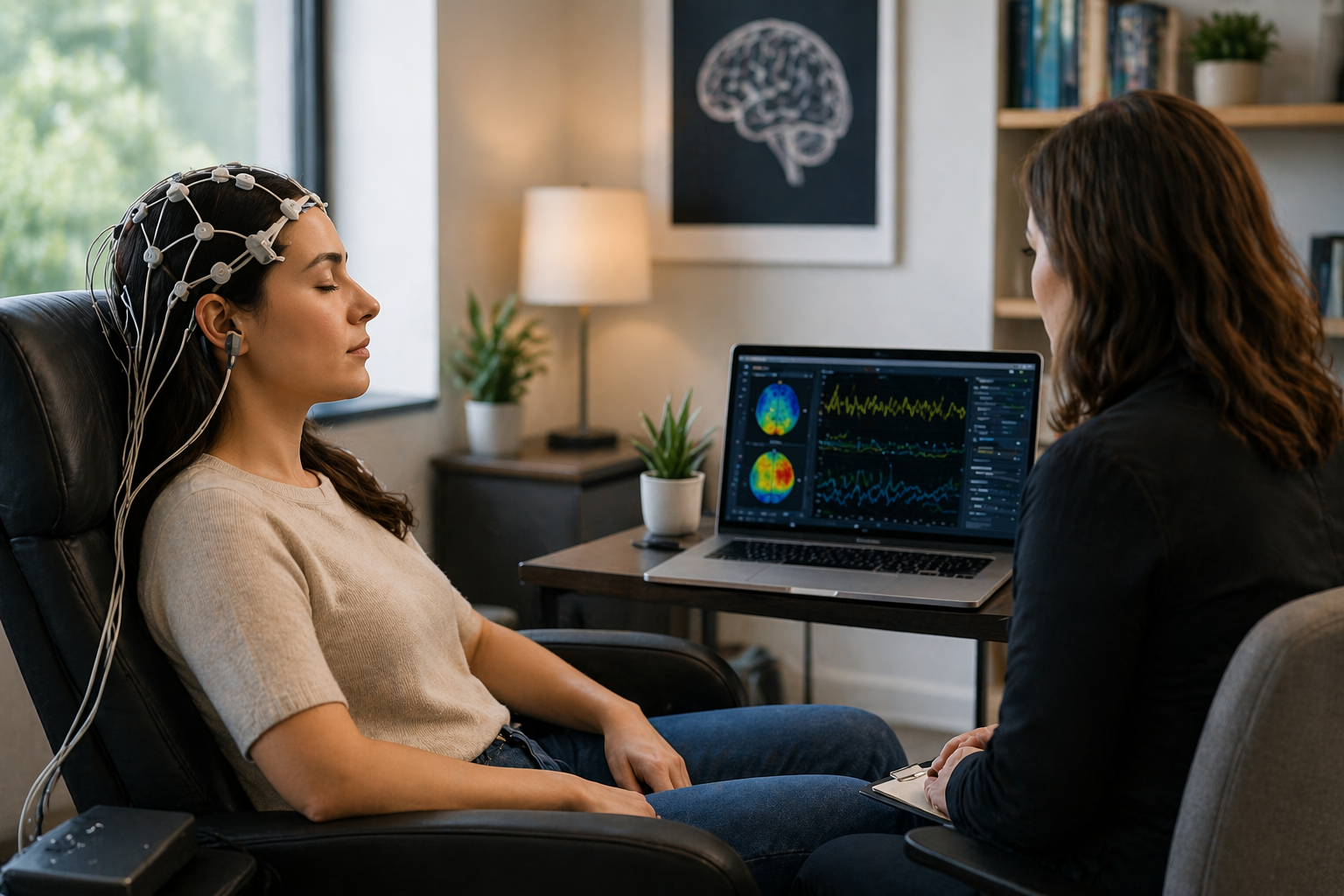
Protocols vary by condition and clinic. EEG-based approaches, like those reviewed by the AAP, typically involve repeated sessions targeting specific brainwave patterns. The fMRI-based work in the double-blind randomized controlled trial required patients to actively practice techniques for quieting rumination while receiving live feedback on their brain’s response. The pilot combined brief mindfulness training with a scanner-based session in which participants worked to shift their brain’s network activity in real time.
None of that is passive. Each protocol involves active engagement and a course of repeated visits. In clinical practice, neurofeedback tends to sit alongside existing care, working on what’s specific and unresolved.
The Balanced Reality: What Neurofeedback Does Not Do
VA/DoD clinical practice guidelines for major depressive disorder reviewed the biofeedback evidence and concluded there was insufficient evidence to recommend it for MDD, describing the supporting studies as limited and of very low quality. For depression, major U.S. guideline bodies are still cautious.
For ADHD, neurofeedback has never received FDA approval as an efficacious treatment despite decades of clinical use. Some studies show real benefit, and some clinics offer it widely, but it doesn’t occupy the same regulatory position as first-line ADHD care.
That doesn’t make it useless. It makes it an emerging adjunct, still being understood, used alongside established treatment rather than instead of it.
Let Zeam Help You Explore What’s Next
Neurofeedback shows the most clinical promise for ADHD and for depression-related rumination. For anxiety, it’s being explored as part of a transdiagnostic approach to shared internalizing circuitry. Across all three, the consistent clinical message is the same: It enters care when symptoms persist after standard psychiatric treatment has been tried, not before.
At Zeam, we offer neurofeedback therapy in Sacramento, Folsom, and Roseville, as part of an integrated approach that includes psychiatry, CBT, EMDR, TMS, and ketamine-based options. If your current treatment hasn’t produced the relief you’re looking for, our team can help you evaluate whether neurofeedback is the right next layer for your care plan. Contact us today to schedule a consultation and find out what that could look like for you.
Citations
- https://www.samhsa.gov/data/sites/default/files/reports/rpt56287/2024-nsduh-annual-national-report.pdf
- https://pmc.ncbi.nlm.nih.gov/articles/PMC11334226/
- https://pmc.ncbi.nlm.nih.gov/articles/PMC11371824/
- https://publications.aap.org/pediatrics/article/153/4/e2024065787/196922/Treatments-for-ADHD-in-Children-and-Adolescents-A
- https://bpb-us-e1.wpmucdn.com/sites.northeastern.edu/dist/0/363/files/2023/03/Reducing-default-mode-network-connectivity-with-mindfulness-based-fMRI-neurofeedback-a-pilot-study-among-adolescents-with-affective-disorder-history.pdf
- https://www.healthquality.va.gov/guidelines/MH/mdd/VADODMDDCPGFinal508.pdf