
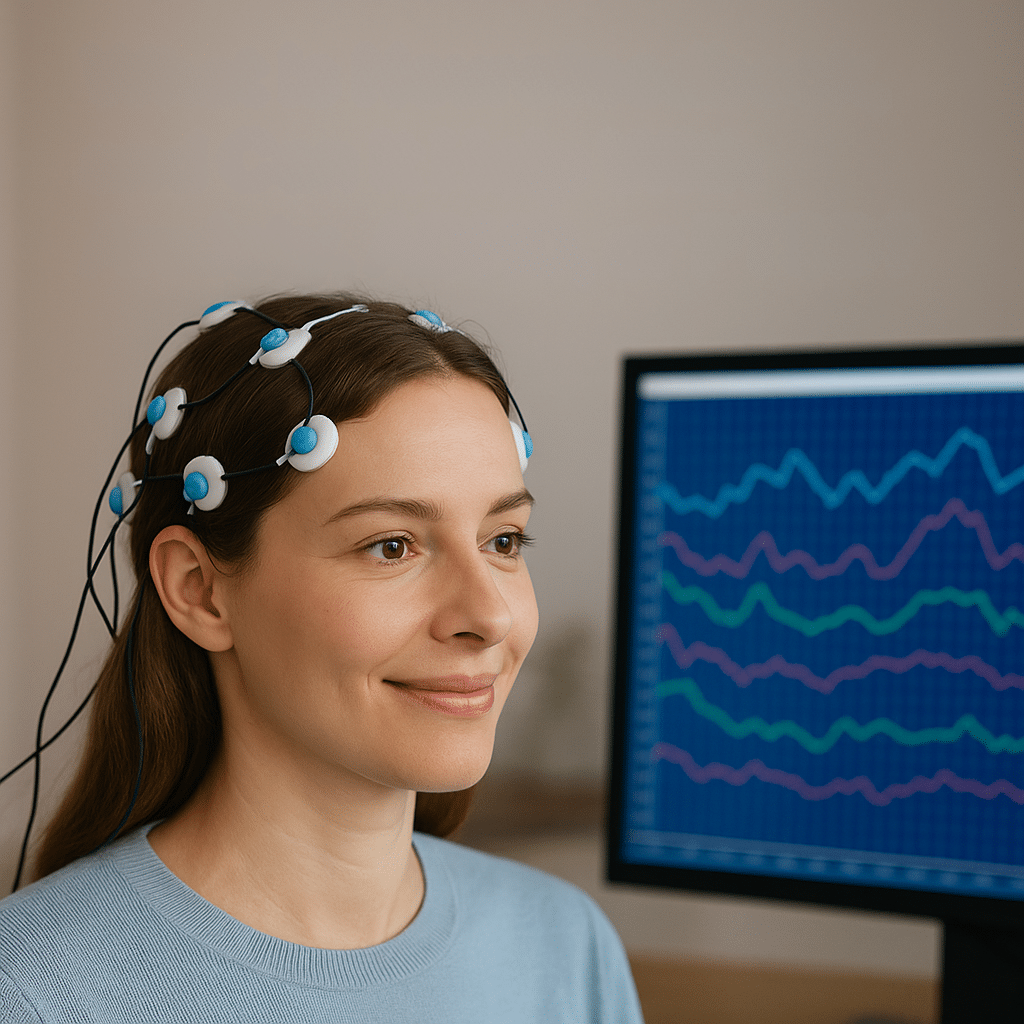
In today’s world, mental health challenges rarely come with simple answers. For some people, therapy or medication works. For others, the path to healing is not as straightforward.
Although the technology may seem advanced, the idea behind neurofeedback is surprisingly natural, as it teaches your brain how to better regulate itself. It is science you can watch on a screen, and it is changing lives.
Let us explore what neurofeedback is, how it works, and why it may be the mental health breakthrough you have been searching for.
Quick Answer Summary
Neurofeedback is a non-invasive brain training therapy that uses real-time feedback to help regulate brainwave activity. It can improve symptoms of ADHD, anxiety, and PTSD by teaching the brain to shift toward healthier patterns of focus, calm, and emotional regulation—often without medication.
Key Takeaways
- Neurofeedback trains the brain using real-time feedback through operant conditioning¹
- It is non-invasive, with no medication, stimulation, or sedation required
- ADHD is linked to excess theta waves and reduced focus-related activity, which neurofeedback can help rebalance¹
- Anxiety is associated with high beta brainwave activity, and training can promote calmer states
- PTSD symptoms may improve as neurofeedback stabilizes hyperarousal and emotional dysregulation¹
- Many patients begin noticing improvements in sleep, focus, and mood within 10–15 sessions
- Long-term benefits typically require 30–40 sessions, especially for ADHD and PTSD
- Neurofeedback is most effective when personalized based on individual brainwave patterns
Neurofeedback: What It Is and How It Works
Neurofeedback is a form of brain training that uses real-time data to help you learn how to self-regulate brain activity. It is a non-invasive process. Sensors placed on your scalp detect your brainwaves and translate that data into visual or audio feedback. You may watch a video, play a game, or hear a tone. The feedback reacts to your brain in real time.
If your brainwaves move in a direction that supports healthier functioning, such as calm focus or emotional stability, the system rewards that with clearer visuals or pleasant sounds. If your brain moves off course, the reward fades.
With repetition, your brain learns to maintain the healthier pattern. This process is known as operant conditioning. You get immediate, continuous feedback, and your brain learns to optimize itself.
The best part is that nothing (shocks, drugs, or sedation) is sent into your brain. You remain awake and alert during every session. The therapy is entirely based on helping your brain notice itself and then change in response.
Why Brainwaves Matter in Mental Health
To understand why neurofeedback works, it helps to know a bit about brainwaves. Your brain produces different types of waves depending on what you feel or think.
For example:
- Theta waves (4–8 Hz) increase when you are daydreaming or struggling with focus. They are often seen in ADHD.
- High beta waves (20–32) show up during anxiety, hypervigilance, or racing thoughts.
- Alpha waves (8–13 Hz) support relaxation, quiet alertness, and balance.
Problems arise when these waves show up in the wrong place or the wrong ratio. An ADHD brain might have too much slow theta activity and not enough beta. An anxious brain might struggle to settle into calmer alpha states.
Neurofeedback helps correct those patterns. It aims to eliminate a certain brainwave. It is to train your brain to shift when and where those waves appear.
What Neurofeedback Can Help With
Many mental health conditions share one thing in common: disrupted brainwave patterns. Neurofeedback addresses these imbalances at the source, helping the brain recalibrate itself.
ADHD
People with ADHD often struggle with regulating attention, managing impulses, and filtering distractions. Neurofeedback addresses the root of those symptoms by training the brain to reduce slow-wave activity and strengthen patterns linked to alert focus.
There are multiple subtypes of ADHD based on different EEG profiles. This means that effective neurofeedback must be personalized.
A well-trained clinician maps the brain before treatment and targets the training accordingly. Some people need to increase beta waves. Others need to calm excess theta or enhance coherence between regions of the brain.
Anxiety
An anxious brain often stays locked in high-frequency activity. It lives in hyper-alert mode. The nervous system is always scanning for threats. Over time, this becomes exhausting.
Neurofeedback helps the brain exit this fight-or-flight loop. Sessions focus on increasing calm, stable activity in brain areas involved in emotional regulation. The process is gentle but powerful.
Patients often begin to sleep better, worry less, and feel more present. For those who do not respond well to talk therapy or who feel stuck even with medication, neurofeedback provides a new way forward.
PTSD
PTSD disrupts how the brain processes memory, emotion, and safety. People living with trauma may experience flashbacks, panic, and emotional numbness.
Neurofeedback offers a quiet, nonverbal path to healing. It bypasses the need to talk through painful memories and instead helps the brain restore stability at a foundational level.
Case studies show how consistent neurofeedback can reduce nightmares, hyperarousal, and other trauma symptoms.
How Neurofeedback Supports Different Mental Health Conditions
| Condition | Brainwave Pattern | Neurofeedback Goal | Potential Benefits |
|---|---|---|---|
| ADHD | Excess theta, reduced focus-related activity | Increase focus and attention regulation | Improved concentration, reduced impulsivity |
| Anxiety | Elevated high beta (hyperarousal) | Promote calmer, balanced brain activity | Reduced worry, better sleep, improved relaxation |
| PTSD | Dysregulated arousal and stress response | Stabilize nervous system function | Fewer flashbacks, reduced hypervigilance, emotional balance |
| Sleep Issues | Irregular alpha and beta rhythms | Restore natural sleep-wake balance | Improved sleep quality and recovery |
What a Typical Session Looks Like
Neurofeedback sessions are simple. You arrive and sit comfortably. Sensors are placed on your scalp using a soft headband or cap. You might watch a short video, like a beach scene or an animated puzzle.
When your brain moves into the desired pattern, the video plays clearly. When it drifts, the video dims or glitches slightly. Your brain takes in that feedback and adapts. You are not told what to do; you just learn by watching and adjusting.
Sessions typically last 30 to 60 minutes. Most patients begin to notice changes in mood, sleep, or focus after 10 to 15 sessions.
For ADHD and PTSD, 30 to 40 sessions may be recommended for long-term results. Throughout the process, clinicians monitor your brain data and adjust the training as needed.
Is It Right for You?
If you have tried other treatments and still feel like something is missing, neurofeedback may be worth exploring. It appeals to people who want more than symptom management. It gives you a way to take part in your own mental health journey.
The process is gentle. There are no side effects beyond occasional mental fatigue. Moreover, the benefits often extend beyond the original issue, touching everything from sleep to stress tolerance.
If you are still skeptical, that is fair. However, skepticism should not close the door on options that have helped thousands. Neurofeedback has been studied, refined, and tested.
At Zeam, it is offered as part of a wider healing plan, not a standalone gimmick.
Begin a Smarter, Stronger Path to Wellness
Mental health treatment should not feel like trial and error. At Zeam Health & Wellness, you do not have to guess what works. Our team in Sacramento, Folsom, and Roseville listens to your story, maps your brain, and builds a custom plan designed for your unique needs.
We believe that neurofeedback therapy near you should be accessible, affordable, and part of a full-spectrum approach to care. You deserve clarity, confidence, and a way to retrain your brain toward lasting wellness.
Take the first step today. Schedule a consultation to learn if neurofeedback could be the missing piece in your recovery.
Citations
- PMC – Neurofeedback and Brain Regulation Research:
https://pmc.ncbi.nlm.nih.gov/articles/PMC4892319/ - The New York Times – Neurofeedback Therapy Overview:
https://www.nytimes.com/2022/01/12/well/mind/neurofeedback-therapy-mental-health.html