
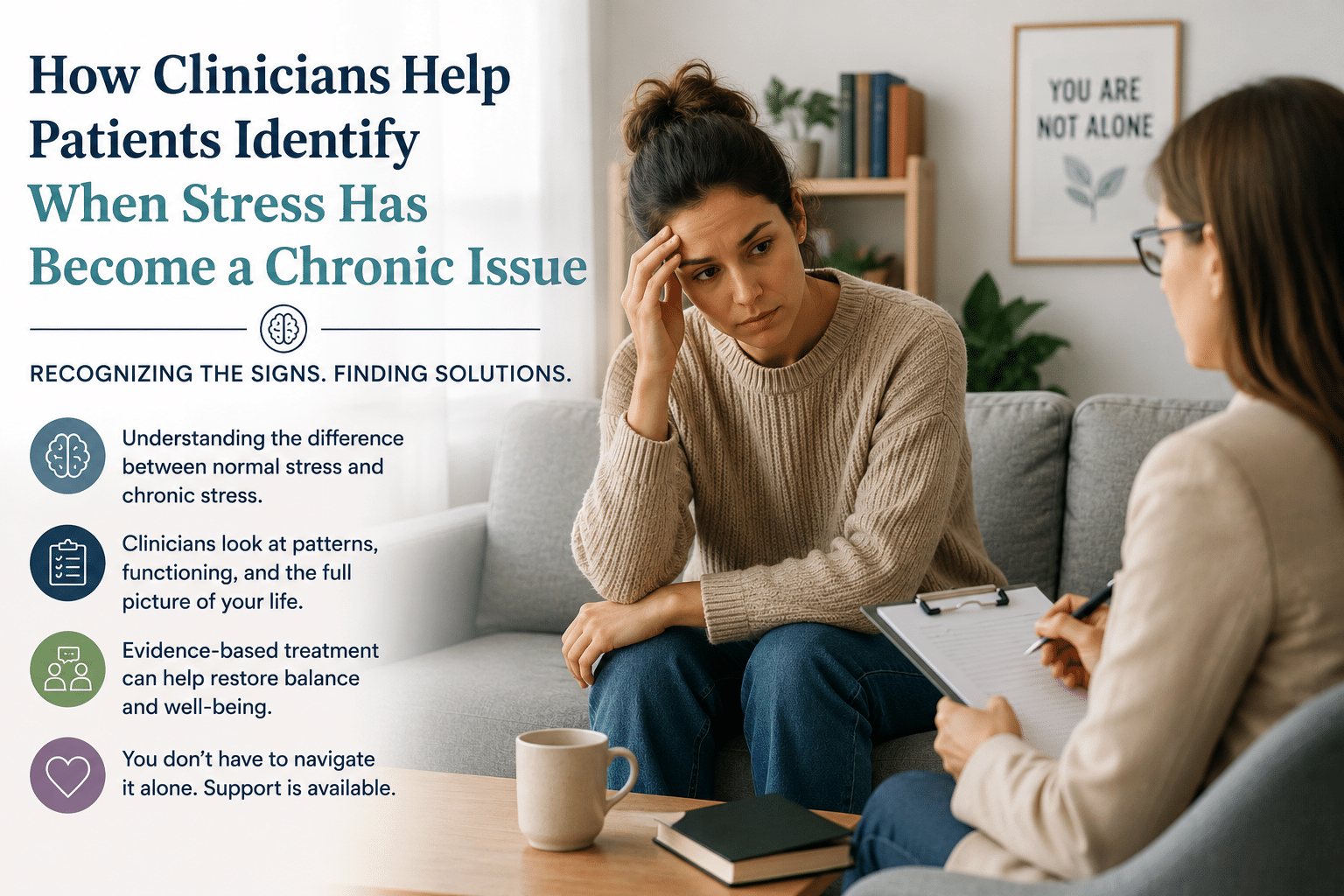
Stress shows up when life asks more of you than usual, and most of the time it fades once the deadline passes or the crisis settles. The trouble starts when it does not fade. A pressure that felt temporary digs in, outlasts the thing that caused it, and quietly reshapes how you sleep, focus, and treat the people around you. Most people miss this shift while it happens, because it builds over weeks or months instead of arriving in one bad moment.
This article explains how clinicians help patients recognize when stress has turned chronic, and what steps can help you recover your balance.
Quick Answer Summary
Stress is a normal response to life’s challenges, but when it persists long after the original trigger has passed, it can begin affecting sleep, concentration, relationships, and overall well-being. Clinicians evaluate how long symptoms have lasted, how they affect daily functioning, and whether they may indicate anxiety, depression, or another mental health condition. Early evaluation and evidence-based treatment can help restore balance before chronic stress becomes more disruptive.¹⁻⁶
Key Takeaways
- Chronic stress often develops gradually, making persistent fatigue, irritability, poor sleep, and difficulty concentrating easy to mistake for everyday life.¹
- Clinicians evaluate both symptoms and daily functioning to determine whether ongoing stress may indicate anxiety, depression, or another mental health condition.²
- Standardized screening tools such as the PHQ-9 and GAD-7 help guide clinical conversations but are only one part of a comprehensive mental health evaluation.⁴
- Financial concerns, medical debt, scheduling difficulties, and uncertainty about where to seek care can delay treatment for chronic stress and related mental health concerns.⁵
- Evidence-based approaches such as mindfulness-based stress reduction, cognitive behavioral therapy (CBT), medication management, and online therapy can all play important roles depending on each person’s needs.⁶
- Seeking an evaluation does not commit someone to a specific treatment plan. Instead, it helps clarify whether chronic stress has progressed into a condition that may benefit from professional support.¹⁻⁶
When Symptoms Become “Normal”
Chronic stress works by making each rough day look a lot like the one before it.
You sleep a little worse, snap a little faster, lose your place mid-task, or notice anxiety symptoms that never used to occupy you. Because the changes arrive slowly, you adapt to them.
Most people reach for a reasonable explanation along the way: a demanding job, a sick parent, getting older, or just a hard stretch of life. Those explanations are not wrong, but they can hide a persistent pattern.
Plenty of people keep hitting their deadlines, which makes the problem easy to wave off, even when they only manage it by sacrificing sleep, exercise, or time with the people they love. The move from short-term stress to lasting distress has no clear starting line, which is exactly what makes it easy to overlook.
According to the National Institute of Mental Health, stress responds to an external cause and may be brief or repeated, while anxiety can linger even after the immediate threat is gone. When the feeling outlasts the trigger, it deserves a closer look.
How Clinicians Identify the Transition
When you describe ongoing stress, a clinician is listening for a pattern rather than a single symptom. The questions usually start with time.
A clinician will ask when the stress began, what set it off, and whether it eases when the original problem improves. Stress that keeps returning, stays high after the situation changes, or spreads into unrelated corners of your life earns a second look. They also ask what you no longer do well. Trouble finishing work, keeping up with the house, showing up socially, or meeting daily responsibilities tells a clearer story than the word “stressed” on its own.
That focus on functioning rests on solid data. A CDC analysis found that among adults who met the threshold for depression, nearly nine in ten (87.9%) reported at least some difficulty with work, home, or social activities, which is why clinicians treat daily disruption as a meaningful signal.
Stress also tends to bleed across different parts of life. In its 2025 Stress in America survey, the American Psychological Association found that adults reporting high loneliness were far more likely than those with low loneliness to feel nervous or anxious, 60% versus 24%, with higher rates of fatigue and headaches, too. Clinicians also lean on short questionnaires.
Tools like the GAD-7 and PHQ-9 put a number on how often symptoms show up, which can reveal that occasional stress is happening most days. These scores organize the clinical conversation rather than replace it.
The USPSTF recommends anxiety screening for adults aged 64 and younger but is clear that a positive screen should lead to further evaluation, to see whether the pattern points toward anxiety disorders, depression, or another concern that needs its own workup.
When Practical Barriers Complicate Recognition
Sometimes the obstacle is not insight. People often sense that something is off and still put off doing anything about it.
Cost, scheduling, and plain uncertainty about where to begin all push an evaluation or a first therapy appointment down the list. Money weighs heavily. A 2025 study found that adults carrying medical debt were far more likely to skip mental healthcare because of cost, 33.8% versus 6.3% of adults without debt.
Practices that work with your insurance and financing can ease part of that hurdle. While the delay stretches on, people adapt to worsening sleep, concentration, and mood, and they start treating those changes as their new normal.
How Treatment Can Create Clarity
Getting evaluated does more than assign a label. It often pulls the fog into focus and shows you what has changed.
Working with a clinician helps you map the pieces, connecting triggers to thoughts, physical reactions, and the habits built around them, and it can separate ordinary stress from anxiety or depression. Evidence-based options work.
In one 2024 randomized trial, researchers put mindfulness-based stress reduction head-to-head with the medication escitalopram in adults already diagnosed with an anxiety disorder. Over eight weeks, anxiety scores dropped about the same in both groups. So, medication is one route, not the only one. Psychiatric treatment with medication management tends to enter the picture when symptoms turn moderate or severe, hang on despite early efforts, or look like a diagnosable condition.
How you reach care also counts. Online therapy now works for people whose jobs, distance, or daily demands rule out office visits. You can meet a licensed clinician over live video from home, or trade messages whenever it suits your day, and still get real, structured support rather than generic wellness tips.
Self-directed digital CBT can add guided skills practice between sessions, though it does not replace working with a clinician. The right mix depends on your symptoms, your history, and what you want, and a careful evaluation is what sorts that out.
The Transition You Cannot See Is the One You Can Address
Recognizing chronic stress is less about pinpointing one turning point and more about noticing what keeps going after the original pressure has eased. An evaluation does not lock you into any particular treatment. It clarifies what is happening and what might help.
If you are not sure whether stress has become more than stress, we at Zeam Health & Wellness can help you spot the patterns and decide what kind of support fits your life. Reach out today to schedule a consultation and start with clarity, not a diagnosis.
Chronic Stress & Mental Health FAQs
How do I know if my stress has become chronic?
If stress continues for weeks or months after the original cause has improved—or if it begins affecting your sleep, concentration, mood, relationships, or daily responsibilities—it may have progressed beyond normal short-term stress and deserve a professional evaluation.
What is the difference between stress and anxiety?
Stress is typically a response to an external challenge or event, while anxiety can persist even after the stressful situation has ended. Chronic anxiety may occur without a clear or ongoing trigger.
How do clinicians evaluate chronic stress?
Clinicians review how long symptoms have lasted, how they affect daily functioning, medical history, current stressors, and may use screening tools such as the PHQ-9 or GAD-7 to better understand symptom patterns before making treatment recommendations.
Can chronic stress turn into anxiety or depression?
Yes. Prolonged stress can increase the risk of developing anxiety disorders or depression, particularly when symptoms persist, interfere with daily life, or go untreated for extended periods.
Can therapy help with chronic stress?
Yes. Cognitive behavioral therapy (CBT), mindfulness-based therapies, and other evidence-based approaches can help people better manage stress, improve coping skills, and reduce the impact stress has on daily life.
When should I seek professional help for stress?
Consider speaking with a mental health professional if stress has lasted for several weeks, affects your work or relationships, disrupts your sleep, or leaves you feeling overwhelmed despite your usual coping strategies.
Citations
- National Institute of Mental Health (NIMH). I’m So Stressed Out! Fact Sheet. Available at: https://www.nimh.nih.gov/health/publications/so-stressed-out-fact-sheet
- Centers for Disease Control and Prevention (CDC). Symptoms of Anxiety and Depression Among Adults: United States, August 2021–August 2023. Available at: https://www.cdc.gov/nchs/data/databriefs/db527.pdf
- American Psychological Association. Stress in America™ 2025 Report. Available at: https://www.apa.org/pubs/reports/stress-in-america/2025/full-report.pdf
- U.S. Preventive Services Task Force (USPSTF). Screening for Anxiety Disorders in Adults. Available at: https://www.uspreventiveservicestaskforce.org/uspstf/recommendation/anxiety-adults-screening
- JAMA Health Forum. Medical Debt and Forgone Mental Health Care Among U.S. Adults. Available at: https://jamanetwork.com/journals/jama-health-forum/fullarticle/2832767
- JAMA Network Open. Mindfulness-Based Stress Reduction vs Escitalopram for Anxiety Disorders. Available at: https://jamanetwork.com/journals/jamanetworkopen/fullarticle/2824672