Most people start anxiety treatment with some version of the same question in the back of their mind: Is this actually doing anything? It’s a fair thing to wonder. Anxiety is deeply personal, and progress can feel slippery. A good week doesn’t always mean treatment is working. A hard week doesn’t mean it isn’t.
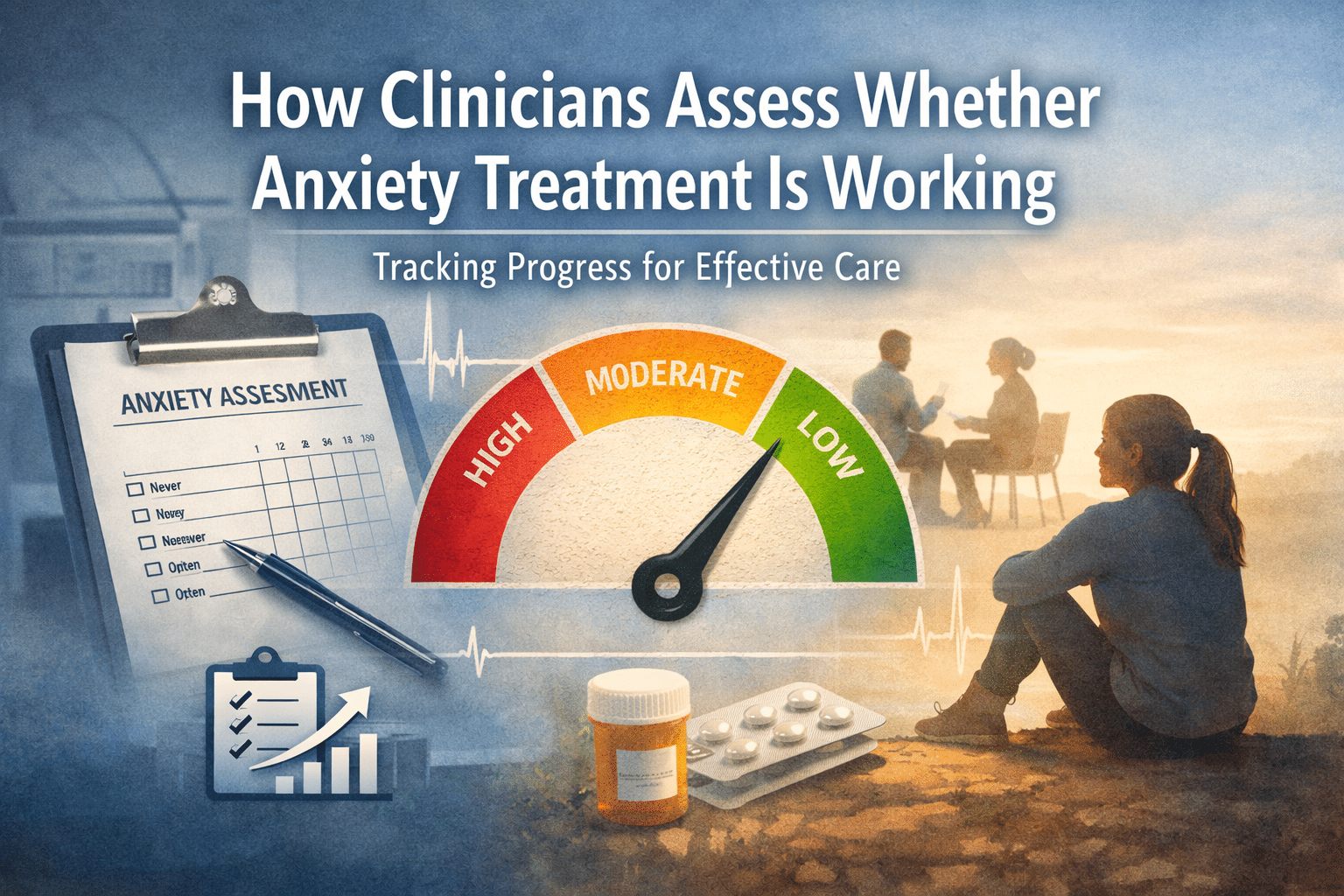
That uncertainty is exactly why clinicians don’t rely on how you’re feeling on a given Tuesday. They use structured, repeatable methods to track progress, tools that cut through the day-to-day noise and show whether an anxiety disorder is responding to treatment over time.
This article walks through how that assessment works and what it means when something needs to change.
Quick Answer Summary
Clinicians evaluate whether anxiety treatment is effective by using structured assessment tools, symptom rating scales like the GAD-7, and real-world indicators such as sleep, relationships, and daily functioning. Establishing a baseline helps providers track changes over time rather than relying on day-to-day feelings. If symptoms plateau or functional improvement stalls, clinicians may adjust medications, therapy approaches, or consider alternative treatments. Consistent measurement ensures anxiety care remains responsive and evidence-based.
The Baseline: Establishing Where You Started
Before any meaningful comparison can happen, a clinician needs to know where you started. That first assessment is paperwork as well as the reference point against which everything else gets measured.
A thorough baseline covers symptom history, like how long you’ve been experiencing anxiety symptoms, what triggers them, how often they occur, and how anxiety is affecting daily life.
According to data published by NIMH from the National Comorbidity Survey Replication, more than half (56.5%) of U.S. adults with an anxiety disorder experience at least moderate functional impairment. A baseline that captures that context gives the clinician something concrete to track across time, rather than comparing feelings to feelings.
Standardized Rating Scales: Measuring the Measurable
Once a baseline exists, clinicians use validated scales to track anxiety symptoms at regular intervals. The most common is the Generalized Anxiety Disorder 7-item scale (GAD-7), developed and validated by Spitzer and colleagues in a large U.S. primary care sample. Patients complete it in under two minutes.
Scores range from 0 to 21, with anything above 10 considered clinically significant. The threshold where the original validation study identified GAD with 89% sensitivity and 82% specificity.
Clinicians use two benchmarks to help them understand how things change over time: treatment response, which is when the score drops by 50% or more from the starting score, and remission, which is when the score falls below 5.
In a 2025 study tracking nearly 3,000 U.S. adults through a structured outpatient practice, routine GAD-7 and PHQ-9 monitoring was tied to 65.8% of patients showing reliable improvement mid-treatment and 79.2% by the end. That kind of visibility only exists if someone’s actually measuring.
Functional Improvement: The Real-World Measure
Scale scores capture something, but not everything. Clinicians treating anxiety disorder also look at what’s happening outside the office, whether gains on paper are translating into an actual change in how someone lives.
The questions are concrete:
- Is the patient returning to activities they’d been avoiding?
- Are they sleeping?
- Are relationships less strained?
A 2024 meta-analysis by Cuijpers et al., covering 441 trials and 33,881 patients across eight mental disorders, found that the absolute psychotherapy response rate for generalized anxiety disorder was 36%. Because response rates are modest, clinicians often need more than symptom scores alone to judge whether treatment is producing meaningful progress.
Restored function can be a better indicator of real-world recovery than symptom scores alone. Someone with mild remaining anxiety who’s back at work and maintaining relationships has recovered in the ways that matter most.
Tracking Severe Symptoms and Safety
Not all anxiety symptoms carry the same clinical weight. Certain indicators, such as panic attack frequency, the presence of suicidal thoughts, and self-harm urges, get particular attention because their reduction is a primary marker of stabilization, not just improvement.
For patients dealing with severe anxiety symptoms, clinicians track whether attacks are becoming less frequent, less intense, or shorter in duration. Longer windows of stability between episodes also matter. This isn’t a separate layer of assessment; it’s woven into the same ongoing picture of scale scores and functional markers.
A systematic review by Papola et al. of 65 studies involving 5,048 adults with GAD found that CBT, the psychotherapy with the strongest long-term evidence, remained more effective than treatment as usual at 3 to 12 months after treatment. That is one reason clinicians track more than immediate symptom relief when they assess whether anxiety treatment is holding up over time.
Signs Treatment Needs Adjustment
Stalled progress is information, not failure. When scores stop moving and functional improvement levels off, that’s a clinical signal that the current approach deserves a second look.
For medication, the NIMH notes antidepressants typically need 4 to 8 weeks before their full effect is visible. That’s when an initial reassessment makes sense. For therapy, clinicians usually look for measurable movement over the early course of treatment, but the timeline varies by severity, treatment approach, and how consistently care is delivered.
When a plan stops working, the path forward depends on where things broke down. A medication that hasn’t moved the needle after 6 to 8 weeks might get adjusted in dose, agent, or both. If therapy has been more supportive than structured, a shift to cognitive behavior therapy is often the next move.
Papola et al.’s findings on its long-term durability make it hard to argue against when someone hasn’t tried it yet. Patients who’ve already been through those options without adequate relief may be candidates for something less conventional. Neurofeedback, ketamine-assisted therapy, or TMS aren’t first-line treatments, but they exist for a reason.
What makes any of this work is having data behind the decision. Tracking patient progress through validated measures and actually using those numbers to guide care remains surprisingly rare in psychiatric practice. Providers who do it catch plateaus earlier and respond faster.
The Compass for Your Healing Journey
Assessing whether anxiety treatment is working isn’t one thing. It’s a combination of standardized scores, real-world function, safety monitoring, and direct conversation, all compared against a meaningful starting point.
That full picture is how a good clinician knows what’s happening and what to do next. Adjustments aren’t setbacks. They’re part of how responsive care is supposed to work.
If you’re in Sacramento, Folsom, or Roseville, and are in treatment and unsure whether it’s working or ready to start, and want it done right, our team at Zeam can help. We use evidence-based assessment to guide your anxiety disorder care plan, tracking your progress throughout so nothing gets missed. Contact us today to schedule an evaluation.
Key Takeaways
- Clinicians establish a baseline before treatment begins – Before therapy or medication starts, providers document symptom history, triggers, and functional impact to create a reference point for measuring progress over time.¹
- Standardized scales track symptom change – Validated tools like the GAD-7 allow clinicians to quantify anxiety symptoms and determine whether patients are improving, responding to treatment, or reaching remission.
- Functional improvement matters as much as symptom scores – Clinicians assess whether patients are returning to normal activities, improving sleep, and repairing relationships, since real-world functioning often reflects recovery better than symptom scores alone.³
- Severe symptoms are monitored closely – Indicators such as panic attacks, suicidal thoughts, or self-harm urges are tracked because reductions in these symptoms signal stabilization and improved safety.
- Treatment plans are adjusted when progress stalls – If scores stop improving or functioning plateaus, clinicians may modify medication, shift therapy approaches (such as CBT), or consider other treatment options depending on the patient’s response timeline.²
- Evidence-based monitoring improves outcomes – Regular measurement of symptoms and functioning allows providers to detect plateaus early and adjust care faster, improving long-term treatment success.⁴
Citations
- National Institute of Mental Health. Anxiety Disorders Statistics.
https://www.nimh.nih.gov/health/statistics/any-anxiety-disorder - Spitzer RL et al. Validation of the GAD-7 scale in primary care populations.
https://jamanetwork.com/journals/jamainternalmedicine/fullarticle/410326 - Cuijpers P et al. Meta-analysis of psychotherapy response rates across mental disorders.
https://pmc.ncbi.nlm.nih.gov/articles/PMC11083862/ - Papola D et al. Long-term outcomes of CBT for generalized anxiety disorder.
https://pmc.ncbi.nlm.nih.gov/articles/PMC10585589/