Most people know what it feels like to be anxious. The night before a big presentation, the moment you hit send on a difficult email, or the background hum of worry during a stressful month at work. Anxiety is part of being human because it’s wired into us.
Still, somewhere between “I feel anxious” and “I have an anxiety disorder,” there’s a line. And a lot of people aren’t sure which side of it they’re on.
Here’s how clinicians approach that distinction.
Quick Answer Summary
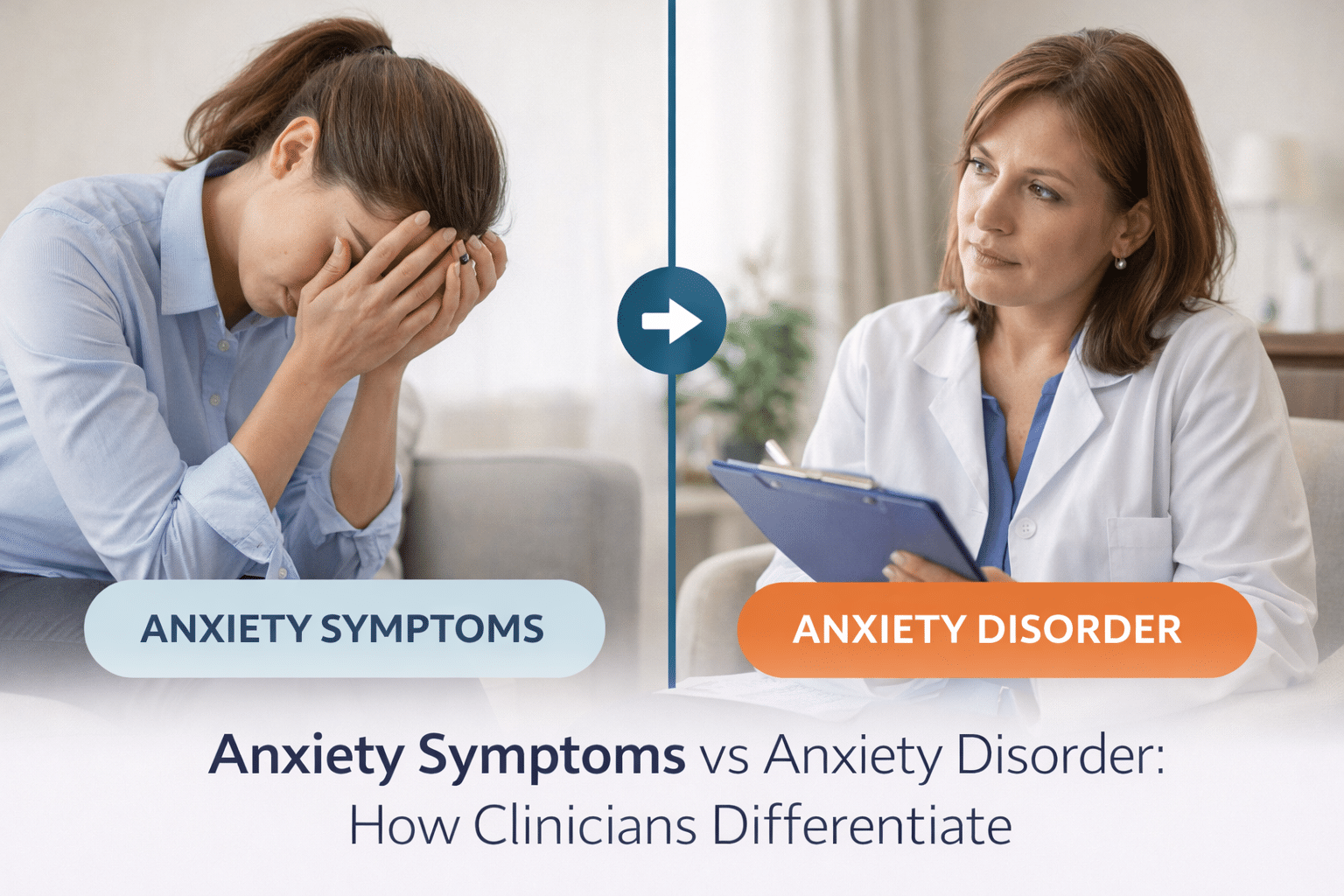
Normal anxiety is a temporary, proportionate response to stress, while an anxiety disorder involves persistent, excessive anxiety that recurs and interferes with daily functioning. Clinicians usually differentiate the two by looking at three core factors: how long symptoms last, how severe and disproportionate they feel, and whether they disrupt work, relationships, sleep, or daily life. A screening tool can suggest concern, but only a full clinical evaluation can determine whether someone meets criteria for a diagnosable anxiety disorder.
What Normal Anxiety Actually Looks Like
Anxiety, at its baseline, is adaptive. The American Psychiatric Association (APA) describes it as a normal reaction to stress, one that can even be beneficial in certain situations by sharpening attention and alerting us to potential threats.
Normal anxiety symptoms tend to be situational. They show up in response to identifiable stressors and fade when the stressor resolves. Feeling nervous before a job interview, tense during a conflict, or on edge before medical results come back are proportionate responses to real circumstances. They’re uncomfortable, but they don’t typically interfere with a person’s ability to function over time.
The APA draws the core distinction this way: Anxiety differs from an anxiety disorder in that the disorder involves excessive fear or anxiety that persists, recurs, and starts to disrupt daily life. That shift, from temporary and proportionate to persistent and impairing, is exactly what clinicians are listening for.
When Anxiety Symptoms Become a Clinical Concern
The clinical framework that guides diagnosis in the United States is the DSM-5-TR. It doesn’t diagnose based on the presence of anxiety alone. For generalized anxiety disorder (GAD), one of the most common forms, the criteria require excessive anxiety and worry occurring more days than not for at least six months, across multiple areas of life.
Beyond duration, adults must also experience at least three of six specified symptoms:
- Restlessness
- Fatigue
- Difficulty concentrating
- Irritability
- Muscle tension
- Disrupted sleep
NIMH data from the National Comorbidity Survey Replication show what that functional impact looks like. Among U.S. adults with any past-year anxiety disorder, 22.8% had serious impairment, and 33.7% had moderate impairment, as measured by the Sheehan Disability Scale.
The Three Factors Clinicians Weigh
When a clinician is evaluating whether someone’s anxiety symptoms represent a disorder, three things tend to do most of the diagnostic work: duration, severity, and functional impairment.
Duration asks how long this has been happening. Anxiety triggered by a life event and resolving after a few weeks is different from worry that has quietly dominated someone’s experience for half a year.
Severity looks at how frequent and disproportionate the anxiety is:
- Is the response roughly calibrated to the actual threat?
- Does it feel out of control?
Functional impairment asks whether anxiety is actually changing how someone lives:
- Are they avoiding things?
- Missing work?
- Struggling in relationships?
The 2024 NSDUH, released by SAMHSA and based on 70,241 participants across all 50 states, found that 7.4% of adults had moderate or severe GAD symptoms. SAMHSA explicitly notes that this figure reflects symptom burden, not clinical diagnoses. A high GAD-7 score does not automatically confirm that someone meets DSM-5 criteria for GAD. That’s a meaningful distinction that only a thorough clinical evaluation can resolve.
What Severe Anxiety Symptoms Signal, and When to Get Evaluated
Not everyone who experiences severe anxiety symptoms meets criteria for an anxiety disorder. Similarly, not everyone with a diagnosable anxiety disorder presents at the severe end of the spectrum. But certain patterns are signals worth taking seriously.
Functional impairment is the clearest indicator. When anxiety is driving avoidance of social situations, of work tasks, or of leaving the house, that moves it out of the “normal stress response” category. When it’s disrupting sleep consistently, eroding relationships, or making basic daily activities feel impossible, that warrants professional attention.
NIMH data show that serious impairment affects nearly 1 in 4 adults with an anxiety disorder. Those individuals are unlikely to improve meaningfully without structured support.
According to the AAFP, evaluation for anxiety should be considered when someone presents with recurrent, pervasive worry or somatic symptoms that can’t be explained by an underlying medical condition. That’s a reasonable rule of thumb for anyone trying to decide whether what they’re experiencing deserves a clinical conversation.
Anxiety Treatment Options After a Formal Diagnosis
Once a clinician determines that someone meets criteria for an anxiety disorder, the path forward is clearer. Anxiety treatment is well-supported by evidence, and most people who receive appropriate care do improve.
The AAFP’s 2022 clinical review identifies cognitive behavioral therapy (CBT) as the psychotherapy with the strongest evidence base across anxiety disorders. It’s structured, focused on patterns of thought and behavior, and has demonstrated effectiveness across GAD, panic disorder, and social anxiety disorder.
Other anxiety treatment options include SSRIs and SNRIs as first-line pharmacotherapy, with no evidence favoring any particular SSRI over another for anxiety conditions. Combined approaches, pairing therapy with medication, are often more effective for moderate to severe anxiety symptoms than either alone.
Not every diagnosis requires medication. The AAFP notes that anxiety treatment isn’t indicated when symptoms are mild, transient, and not interfering with daily function.
That’s worth knowing, because it means the goal of evaluation isn’t necessarily to start medication but to understand what’s actually going on and respond appropriately. Referral to a psychiatrist is appropriate when there are complex comorbidities, safety concerns, or when initial treatments haven’t produced adequate results.
Getting the Right Answer Starts With the Right Evaluation
Anxiety symptoms and anxiety disorder are not the same thing, but both exist on a continuum, and the line between them isn’t always obvious from the inside. Duration, functional impairment, and the degree to which anxiety is reshaping daily life are the factors that matter most clinically. A screening tool can flag the possibility. But only a thorough evaluation by a qualified clinician can provide an actual answer.
At Zeam, we work with patients to do exactly that. Our psychiatric and therapy teams are trained to conduct comprehensive evaluations, work through differential diagnoses, and build individualized anxiety treatment plans, whether that means CBT, medication management, neurofeedback, group support, or a combination.
If you’re in Sacramento, Folsom, or Roseville, and have been wondering whether what you’re experiencing is more than just stress, we’d rather you have clarity than continue guessing. Request an appointment at any of our Sacramento-area locations, and let’s figure it out together.
Key Takeaways
- Normal anxiety is adaptive and usually tied to a specific stressor, while anxiety disorders are more persistent, recurrent, and impairing.¹
- For generalized anxiety disorder, DSM-5-TR criteria require excessive worry on more days than not for at least six months, along with associated physical and cognitive symptoms.²
- Clinicians typically focus on three core factors: duration, severity, and functional impairment.
- Functional impairment is one of the clearest warning signs that anxiety may have crossed into a clinical disorder.³
- National survey data show that symptom burden and formal diagnosis are not the same thing, which is why screening tools alone are not enough.⁴
- CBT has the strongest psychotherapy evidence base across anxiety disorders, while SSRIs and SNRIs remain first-line medication options when treatment is needed.⁵
- Mild, short-term anxiety that does not interfere with daily function does not always require medication or formal treatment.⁵
Citations
- https://www.psychiatry.org/patients-families/anxiety-disorders/what-are-anxiety-disorders
- https://www.psychiatry.ru/siteconst/userfiles/file/book/%D0%90%D0%BD%D0%B3%D0%BB%D0%BE%D1%8F%D0%B7%D1%8B%D1%87%D0%BD%D0%B0%D1%8F%20%D0%BB%D0%B8%D1%82%D0%B5%D1%80%D0%B0%D1%82%D1%83%D1%80%D0%B0%20%D0%BF%D0%BE%20%D0%BF%D1%81%D0%B8%D1%85%D0%B8%D0%B0%D1%82%D1%80%D0%B8%D0%B8/DSM%205%20TR-APA%20(2022).pdf
- https://www.nimh.nih.gov/health/statistics/any-anxiety-disorder
- https://www.samhsa.gov/newsroom/press-announcements/20250728/samhsa-releases-annual-national-survey-on-drug-use-and-health
- https://www.aafp.org/pubs/afp/issues/2022/0800/generalized-anxiety-disorder-panic-disorder.html