
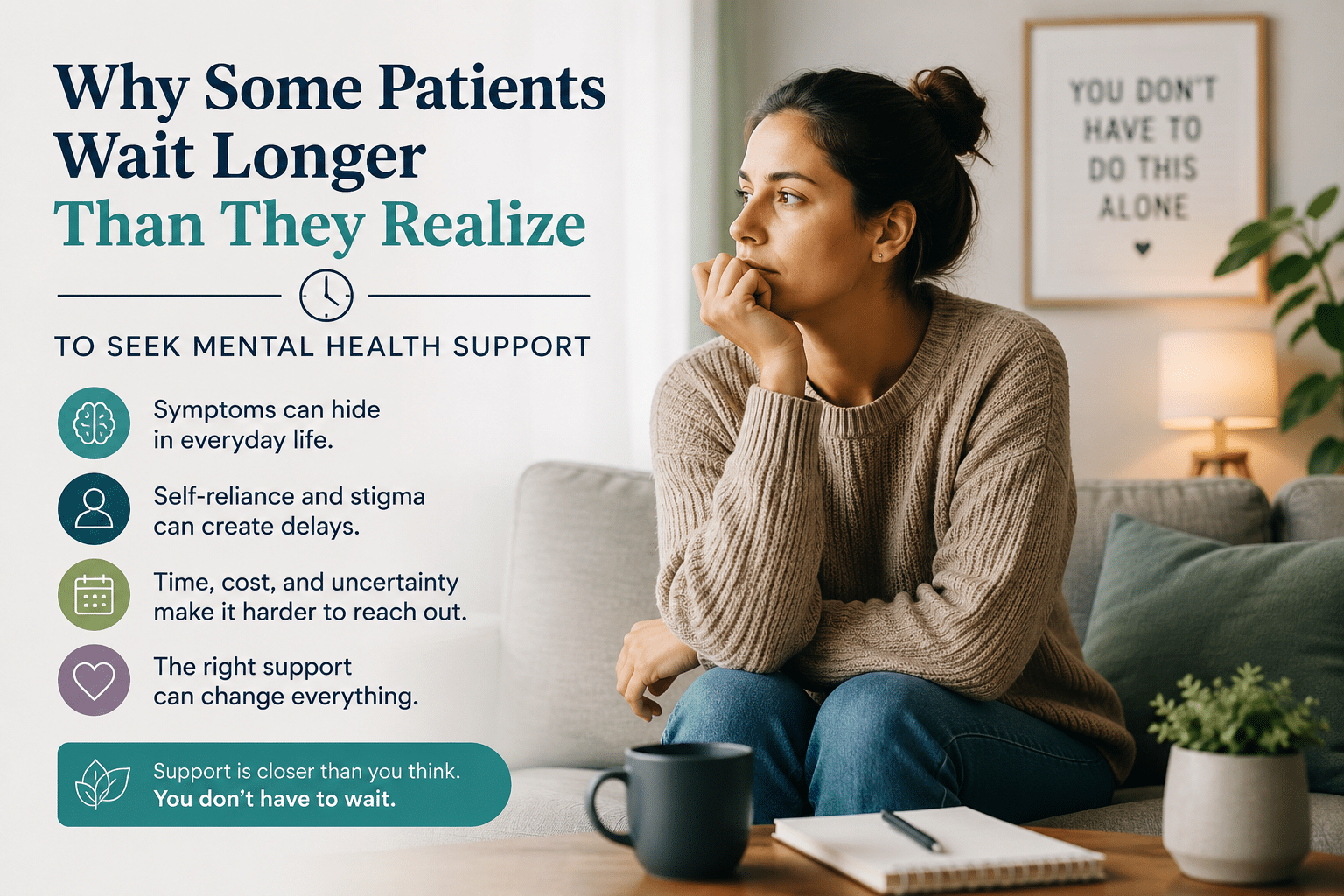
Most people do not wake up one morning and decide to put off mental health care. The change usually arrives slowly: Energy dips, sleep gets worse, patience runs thin, and motivation fades, and each shift feels small enough to explain away.
Because the signs are so easy to misread, the gap between when symptoms start and when someone finally reaches out can stretch across months or even years. That delay rarely means a person stopped caring about their well-being. It usually means the signals were quiet, gradual, and simple to fold into an already full life.
This article walks through the most common reasons people wait, along with the practical steps that can shorten the distance between noticing something is off and getting support.
Quick Answer Summary
Many people wait months or even years before seeking mental health support because symptoms often develop gradually and become easy to dismiss as stress, aging, or simply a busy season of life. Research shows that most untreated adults with a mental illness do not recognize they need care, while others delay treatment due to self-reliance, cost, time constraints, stigma, or uncertainty about the process. Early evaluation can help identify concerns before they become more disruptive and provide personalized treatment options that fit each person’s needs.¹
Key Takeaways
- Mental health symptoms often develop gradually, making anxiety, depression, and emotional exhaustion easy to mistake for everyday stress or personality changes.¹
- Nearly 8 in 10 adults with an untreated mental illness did not believe they needed treatment, highlighting how difficult it can be to recognize mental health concerns.¹
- Many people delay seeking care because they believe they should be able to manage their symptoms on their own, even when professional support could help.¹
- Practical barriers such as cost, scheduling, transportation, and uncertainty about where to find care remain significant obstacles to mental health treatment.¹
- Concerns about medication, privacy, and stigma continue to prevent many individuals from reaching out for therapy or psychiatric care.¹
- Therapy and psychiatric evaluations are designed to provide clarity, education, and personalized treatment options—not pressure patients into a specific course of care.¹
- Early intervention often makes mental health concerns easier to manage by addressing symptoms before they significantly affect work, relationships, sleep, and daily functioning.¹
When Symptoms Blend Into Everyday Life
Anxiety, low mood, and emotional exhaustion rarely announce themselves. They tend to build in the background until they feel like part of your personality rather than something worth treating.
You might notice less patience with your kids, trouble focusing at work, or a motivation that just will not come back. Those shifts are easy to file under work stress, getting older, caregiving demands, or simply “a rough season.” The trouble is that low energy and restless worry can be early anxiety symptoms rather than a passing mood, and treating them that way keeps them off your radar.
The data shows how common this blind spot is. In the 2024 National Survey on Drug Use and Health, SAMHSA found that among untreated adults with a mental illness, nearly 8 in 10 (79.0%) did not see themselves as needing treatment at all. Even among adults with a serious mental illness, more than half did not recognize an unmet need.
The longer symptoms go unnamed, the more they harden into a person’s “normal.” Once something feels normal, it stops feeling like a reason to book an appointment, which is exactly why people who could benefit from depression treatment often wait far longer than they intended.
The Self-Reliance Trap: “I Should Be Able to Handle This”
Even people who do sense something is wrong often decide to tough it out. Self-reliance is one of the most common reasons care slides to the bottom of the to-do list.
Among adults who recognized a need but stayed untreated, roughly 7 in 10 (71.0%) said they believed they should be able to handle the problem on their own, according to the same SAMHSA survey. That instinct is not stubbornness. It is usually reinforced by years of coping fine, by cultural messages about strength, or by a quiet sense that real help is meant for people who are “worse off.”
The pattern hits high-achieving adults especially hard. They tend to read productivity as proof of wellness and mistake emotional struggle for a discipline problem, so they push harder instead of pausing. Working with a professional through structured therapy can reframe that struggle as something treatable rather than a personal failing.
Practical Barriers: Time, Cost, and Uncertainty
Sometimes the obstacle has nothing to do with mindset. It is the calendar, the bank balance, and not knowing where to begin.
In the SAMHSA data, nearly half (47.9%) of adults with a perceived unmet need pointed to a lack of time, and about two-thirds (65.2%) pointed to cost. Another 49.2% did not know where to find treatment, and roughly 4 in 10 could not track down the provider or program they wanted.
These barriers tend to feed on each other. The harder care feels to reach, the easier it becomes to postpone, and the more time symptoms have to settle in. Flexible formats like online counseling can strip away some of that friction by removing the commute and widening the available appointment times, though insurance, privacy, and clinical fit still matter. For anything that needs a prescriber, psychiatry can be folded into the same plan.
Misconceptions That Keep People From Reaching Out
A lot of hesitation comes from assumptions about what treatment involves. Those assumptions are often wrong, and they can make the first step look far bigger than it is.
The SAMHSA survey captured several of these worries. About a third (34.4%) of adults with an unmet need feared they would be told to take medication, roughly a quarter (26.4%) worried about what other people would think, and nearly a quarter (23.4%) feared their private information would not stay private.
What many people do not realize is that therapy can stand on its own without medication. Psychiatric treatment is collaborative rather than something done to you, and a good clinician builds the plan around your symptoms, history, and preferences. Care for anxiety and related concerns can take several forms, and online formats add flexibility for people juggling work and family. Misunderstanding any of this can turn a manageable first appointment into a step that feels much heavier than it needs to be.
How Evaluation and Treatment Can Shorten the Gap
Reaching out does not lock you into anything. A first appointment is mostly about getting clear on what is happening.
It gives you space to describe what you have noticed and to map out realistic next steps, not a commitment to a particular path. Therapy and psychiatric care are not reserved for crises. They help people recognize their patterns, build coping skills, and address symptoms before those symptoms spread further into work, relationships, sleep, and daily routines.
Flexible delivery makes that earlier start more realistic. Video sessions, message-based counseling, and telehealth can lower the scheduling and travel hurdles that stall so many people, which matters most for those whose biggest barrier was time in the first place. Earlier does not guarantee a faster recovery, but it does give you and a clinician more room to figure out what is going on while it is still easier to manage.
The Moment You Recognize It Is the Moment You Can Change It
Acknowledging that something feels off is not a sign of weakness. It is the start of clarity.
The stretch of time between your first symptoms and your first conversation about them says nothing about your character. It only reflects how easy it is to misread slow, gradual change.
If you have been wondering whether your mood, worry, or exhaustion is worth addressing, our team at Zeam in Sacramento, Folsom, and Roseville can help you find clarity without pressure or judgment. Contact us today to schedule a consultation and start with a conversation, not a commitment.
Waiting for Mental Health Support FAQs
How do I know if I should seek mental health support?
If changes in your mood, anxiety, energy, sleep, motivation, or daily functioning have persisted for several weeks or are interfering with work, relationships, or your quality of life, it may be time to speak with a mental health professional.
Why do so many people wait to seek therapy?
Many people don’t recognize their symptoms as treatable mental health concerns. Others delay care because they believe they should handle the problem themselves, worry about cost, lack time, or are unsure where to begin.
Does going to therapy mean something is seriously wrong?
No. Therapy is not reserved for crises. Many people seek therapy to better understand their emotions, manage stress, improve relationships, or develop healthier coping strategies before problems become more severe.
Will I be forced to take medication if I see a psychiatrist?
No. Psychiatric care is collaborative. A psychiatrist will discuss your symptoms, explain available treatment options, and help you decide whether medication, therapy, lifestyle changes, or a combination of approaches is appropriate for your situation.
Can online therapy make it easier to get help?
For many people, yes. Telehealth and online therapy can reduce barriers such as travel time, scheduling conflicts, and limited access to local providers, making mental health care more convenient and accessible.
Is it better to seek help early rather than wait?
Generally, yes. Addressing mental health concerns early may help prevent symptoms from becoming more disruptive and can make it easier to develop effective coping strategies before problems significantly affect daily life.
Citations
- Substance Abuse and Mental Health Services Administration (SAMHSA). 2024 National Survey on Drug Use and Health (NSDUH): Annual National Report. Available at: https://www.samhsa.gov/data/sites/default/files/reports/rpt56287/2024-nsduh-annual-national-report.pdf