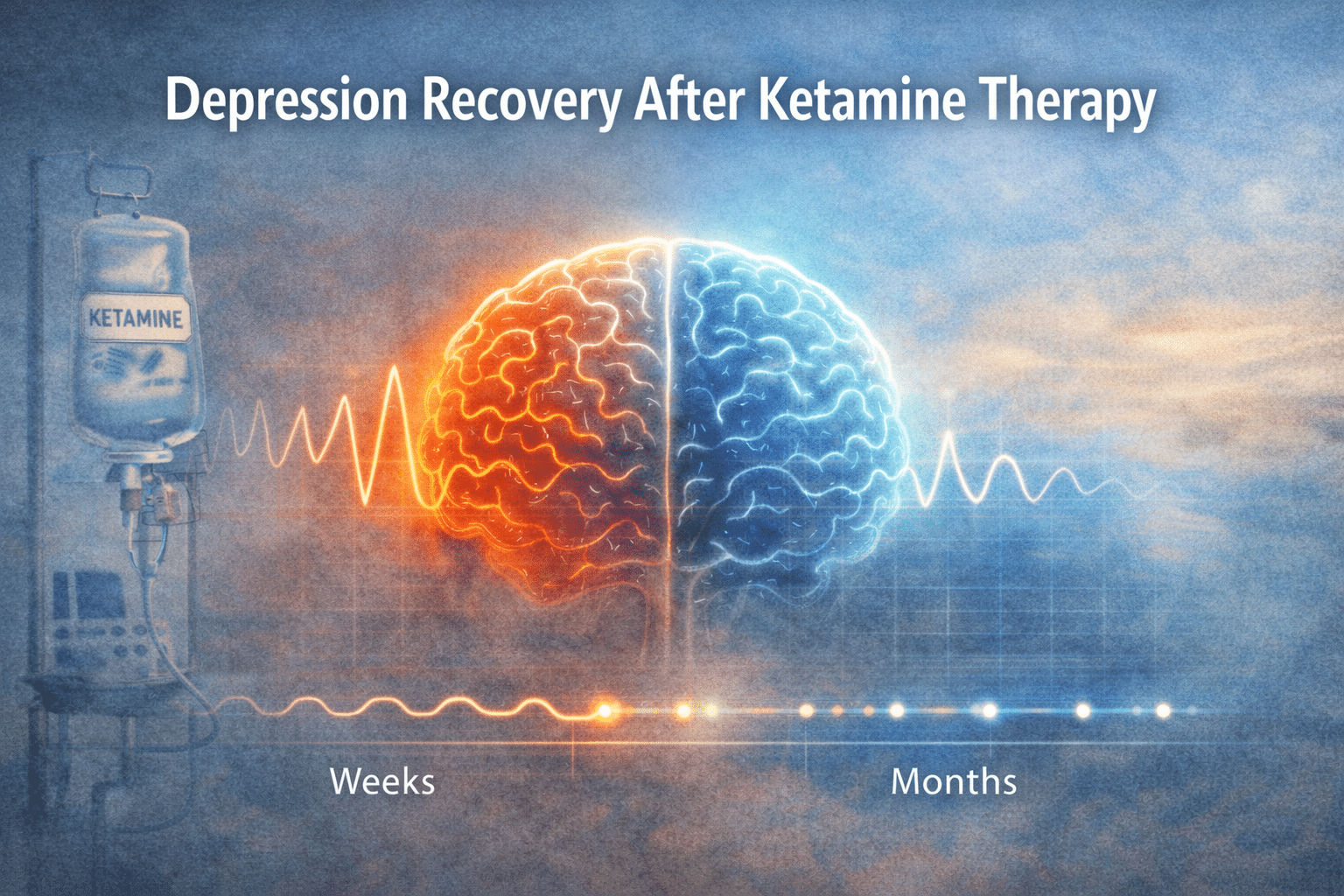
Ketamine infusion therapy works fast. That’s well established. For people with treatment-resistant depression who have been stuck for months or years, the idea of relief within hours rather than weeks is genuinely significant. But speed isn’t the same as durability, and the initial response to a ketamine infusion series is only part of the clinical picture.
What determines whether someone keeps feeling better or slides back within weeks comes down to several factors that unfold after the first series ends. Treatment frequency, how closely symptoms are tracked, whether psychotherapy is integrated, and how the plan adjusts over time all play a role. This is what the research shows.
What the Induction Phase Actually Tells You
The induction phase is where most patients first experience ketamine for depression, and it’s where clinicians get their clearest early signal about how someone responds.
A retrospective analysis by McInnes et al. included 9,016 patients treated across 178 U.S. community practices. Among the 537 patients who completed induction and had sufficient follow-up data, 53.6% achieved clinical response, and 28.9% reached remission 14 to 31 days after induction.
Among patients with baseline suicidal ideation, 73.0% showed a reduction in suicidal thoughts after induction. The overall improvement across the group was clinically substantial.
That’s encouraging, but it’s incomplete. Induction tells you whether the treatment is working. It doesn’t tell you how long it will work, or whether the gains will hold without ongoing care. What happens next matters just as much.
How Treatment Frequency Evolves After Induction
Patients sometimes assume ketamine infusion therapy follows a fixed schedule from start to finish. In practice, the rhythm shifts, and it shifts based on how someone is actually doing.
A Veterans Health Administration study tracked 215 veterans through 12 months of repeated IV ketamine infusions. Early on, sessions came frequently, roughly every five days. As patients stabilized, that spacing stretched out to every three or four weeks. By the end of the year, most had received around 18 infusions total. The schedule wasn’t predetermined. It followed the patient.
FDA prescribing data for Spravato (esketamine) tells a similar story. Among patients who reached stable remission, 69% received every-other-week dosing for most of the maintenance phase. The FDA label also uses a structured schedule early on, then recommends adjusting to the lowest frequency that maintains response or remission.
The pattern across both IV and intranasal protocols is consistent: Early ketamine infusion phases are intentionally frequent to build momentum, and later phases are intentionally lighter to maintain it. Response shapes the plan.
Why Symptom Monitoring Shapes the Long Game
Adjusting frequency is only possible if someone is actually tracking how a patient is doing. Ongoing symptom monitoring is how clinicians decide when to space out sessions, when to stay more frequent, and when a plateau signals something needs to change.
In the VA 2024 study, the 26% of patients who achieved clinical response and the 15% who reached remission by week 6 maintained those improvements at both 12 and 26 weeks, while receiving infusions at decreasing frequency. That pattern only holds if someone is checking. Without regular measurement, early erosion of improvement can go unnoticed until it becomes a full relapse.
The same study also noted that no demographic characteristics or comorbid diagnoses reliably predicted who would hold gains and who wouldn’t. Monitoring is how you find out.
The Role of Psychotherapy in Sustaining Improvement
Ketamine therapy for depression may create a period of increased cognitive and emotional flexibility, which is one reason some clinicians pair it with psychotherapy.
A randomized pilot trial led by Wilkinson and colleagues tested whether cognitive behavioral therapy (CBT) following IV ketamine could sustain antidepressant effects in treatment-resistant depression. Of the 42 patients enrolled, 28 achieved clinical response after six infusions and were randomized to CBT or treatment as usual.
On a secondary depression measure, the CBT group did show significantly greater sustained improvement over time. The authors describe the findings as preliminary and call for larger trials to confirm the effect.
Broader integration of therapy with ketamine treatment also shows durable results. A retrospective effectiveness study by Yermus et al. examining ketamine-assisted psychotherapy (KAP) found that symptom improvements in depression, anxiety, and PTSD were both large and durable, holding up at 3 months and still measurable at 6 months. Improvement extended up to 5 months after the last KAP session. The authors flagged high attrition as a limitation, but the persistence of effects in those who completed follow-up is meaningful.
What the Evidence Says About Long-term Response Rates
It’s worth being direct about what the data actually shows because it doesn’t show that ketamine treatment works for everyone, or that it works indefinitely without attention.
The VA 2024 study is honest about its own results. While 26% of patients achieved response and 15% reached remission, the majority did not meet either threshold by week 6. The authors specifically called for further study on optimal infusion frequency and potential adverse effects with repeated dosing over time.
That’s not a reason to avoid ketamine for depression when it’s appropriate; it’s a reason to treat it as part of a managed plan rather than a standalone fix. Gains that held at 26 weeks in a group with an average of 6.1 prior antidepressant trials over 20 years represent a meaningful outcome. But they require structure to get there.
Long-term Improvement Depends on More Than the Drip
Every year, ketamine infusion therapy helps patients find relief they couldn’t access through other means. But the research is consistent on one thing: Outcomes are shaped by what happens around the infusion, not just during it; the monitoring, the frequency adjustments, the psychotherapy, and the ongoing clinical relationship.
At Zeam, we build our ketamine treatment programs around that full picture. IV ketamine infusions, Spravato, ketamine-assisted psychotherapy, integration sessions, and psychiatric medication management all work together in a coordinated plan. If you want to understand what a structured, individualized approach could look like for your situation, reach out to our team in Sacramento, Folsom, or Roseville to schedule a consultation.
Key Takeaways
- The induction phase shows whether ketamine treatment works initially – Early ketamine infusion sessions help clinicians determine whether a patient responds to treatment. Research involving thousands of patients shows meaningful response and remission rates shortly after induction.¹
- Long-term outcomes depend on maintenance treatment frequency – Infusion schedules often start frequently and gradually extend over time as symptoms stabilize. Studies in clinical populations show treatment spacing evolving from weekly or biweekly sessions to monthly maintenance depending on patient response.²
- Symptom monitoring guides treatment adjustments – Clinicians track depression symptoms over time to determine when infusions should be spaced out, maintained, or adjusted. Regular measurement helps identify early relapse and maintain therapeutic gains.⁴
- Psychotherapy can help sustain improvements – Ketamine treatment may temporarily increase cognitive and emotional flexibility, creating an opportunity for therapies such as CBT or ketamine-assisted psychotherapy to reinforce long-term progress.¹
- Ketamine therapy does not work for everyone – Clinical studies show that while many patients experience meaningful relief, some do not reach remission or response thresholds, highlighting the importance of individualized treatment planning.²
- Coordinated care improves the durability of outcomes – The best long-term results occur when ketamine therapy is integrated with psychiatric care, psychotherapy, and symptom monitoring rather than delivered as a standalone intervention.
Citations
- McInnes et al. Outcomes following ketamine treatment for treatment-resistant depression across community practices.
https://www.sciencedirect.com/science/article/pii/S0165032721014142 - Clinical outcomes of intravenous ketamine treatment in the Veterans Health Administration.
https://www.psychiatrist.com/jcp/clinical-outcomes-intravenous-ketamine-for-depression-va-health-system/ - U.S. Food and Drug Administration. Spravato (esketamine) prescribing information.
https://www.accessdata.fda.gov/drugsatfda_docs/label/2025/211243s016lbl.pdf - Yermus et al. Effectiveness of ketamine-assisted psychotherapy for depression, anxiety, and PTSD.
https://pmc.ncbi.nlm.nih.gov/articles/PMC11613527/