
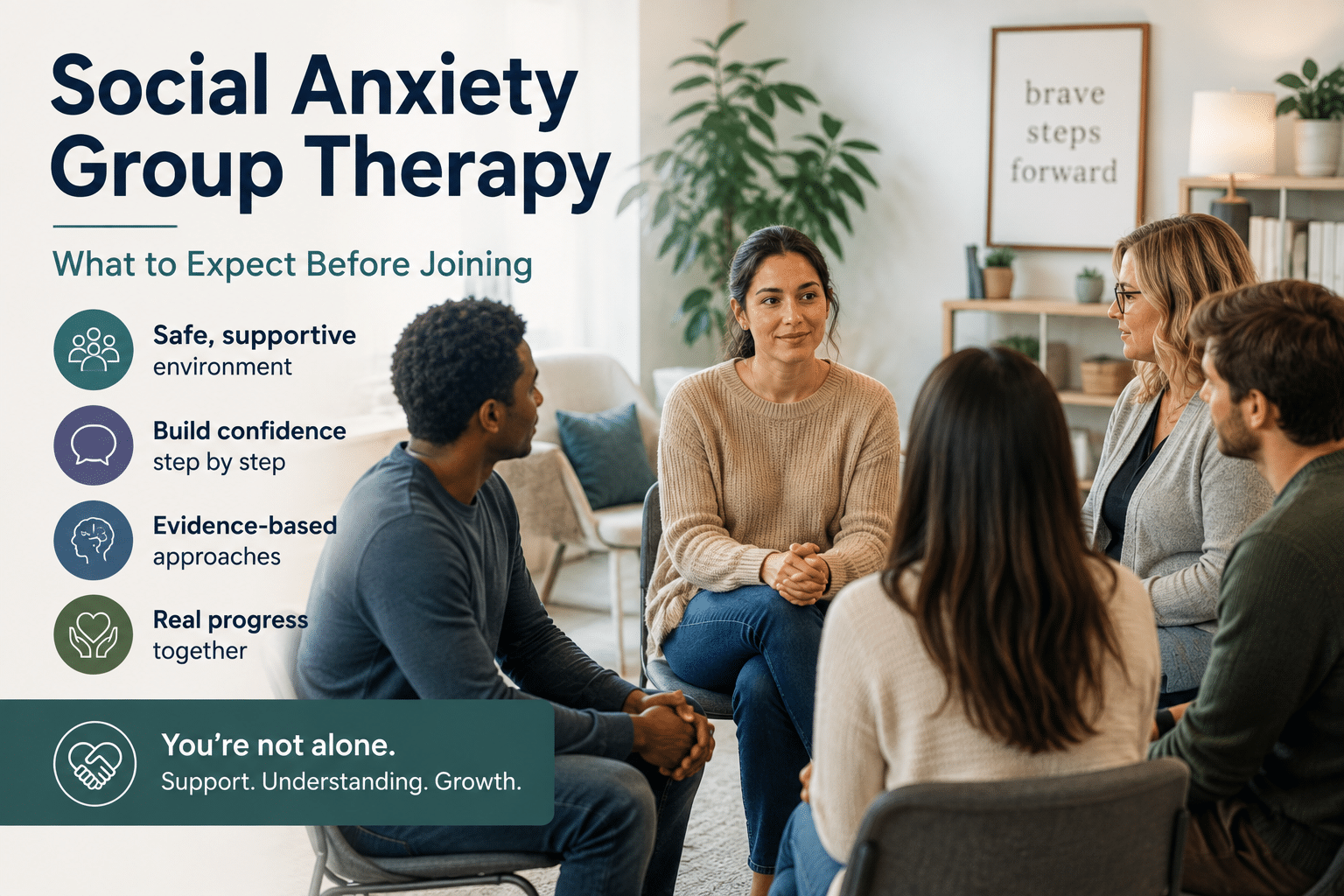
Before anyone sits down for a first group session, the questions pile up. Will I have to speak right away? What am I supposed to share, and how much? What if everyone else already feels comfortable and I am the only one who feels out of place?
Wanting help and dreading the format that help comes in can feel like the same problem wearing two faces. Social anxiety group therapy is built around that exact tension. It is structured and therapist-led, with participation introduced gradually and adjusted with the group leader’s support.
Quick Answer Summary
Social anxiety group therapy is a therapist-led treatment that provides a structured setting to work on fears of judgment, embarrassment, and social interaction.¹ Participation can build gradually rather than requiring intense disclosure immediately, while approaches such as group CBT provide opportunities to challenge anxious predictions and practice social situations in real time.¹⁴ A pre-group intake also helps determine whether the group fits a person’s symptoms, needs, and treatment goals.²
Key Takeaways
- Social anxiety disorder involves persistent fear of being scrutinized, judged, or embarrassed, and treatment commonly uses CBT and gradual exposure to feared social situations.¹
- Before group therapy begins, screening and preparation can help establish whether the group is appropriate while reducing uncertainty and clarifying expectations about participation and confidentiality.²
- A therapy group can provide structured, real-time opportunities to practice social interaction rather than only discussing feared situations outside the therapy room.²
- Research involving people with social anxiety found that both group CBT and mindfulness-based stress reduction were associated with reductions in loneliness compared with a waitlist condition.³
- Controlled research has also found cognitive behavioral group therapy to be an active treatment for social anxiety, with higher treatment-response rates than an educational-supportive comparison condition.⁴
Why the Idea of a Group Feels Harder Than Going It Alone
Social anxiety disorder is not just being shy. It also involves a lasting fear of being watched, judged, or embarrassed in social or performance situations. To be diagnosed, that fear usually lasts at least six months and interferes with work, school, relationships, or daily life.
Avoiding those moments brings quick relief that fades fast. The National Institute of Mental Health notes that social anxiety tends to persist without treatment. That leaves people in an uncomfortable spot, where the situations that would help them most, like practicing conversation, are the same ones their anxiety pushes them to avoid.
At first glance, a room full of people can look like an extension of that same problem. This is exactly why the setting matters as much as the treatment. Social anxiety group therapy is built to engage that fear directly.
What Actually Happens Before You Join a Group
Every group therapy placement starts with a conversation. The process usually begins with an individual intake, where a clinician asks about current symptoms, the situations you tend to avoid, past treatment, and what you are hoping to get out of it. Its purpose is to figure out whether a particular group is a reasonable fit.
Preparation matters more than most people expect. The American Group Psychotherapy Association’s practice guidelines describe pre-group preparation as a way to reduce uncertainty and build trust between a prospective member and the therapist before the first session happens.
Before joining a clinical group, patients typically complete an intake or screening conversation. At Zeam, the intake helps the clinical team determine whether a particular group fits the patient’s needs, readiness, and goals.
Why Participation Builds Gradually
A common fear that keeps people from calling is the idea that joining means exposing something deeply personal on day one. In practice, early participation tends to involve listening, giving a short introduction, completing a brief check-in, or trying a lower-pressure exercise while you learn how the group works.
Therapy for social anxiety generally asks for active practice, and that practice builds gradually over time. The NIMH describes exposure work as a progressive process, where a person works toward feared situations step by step, starting with the easier ones.
A typical session reflects that same rhythm: a check-in, some education on anxiety and avoidance, a bit of cognitive work on unhelpful predictions, practice suited to where you are that week, feedback, and a close that sets up what to try before the next meeting.
How the Group Itself Becomes Part of the Treatment
In one-on-one sessions, you talk about social situations with a therapist. In a group, social interaction is already happening, creating a structured place to practice speaking, disagreeing, or remaining present while others are paying attention. That difference is part of why group therapy for anxiety is a form of real-time social practice that differs from individual therapy.
It also gives you a way to test assumptions you might not realize you are making, like believing everyone in the room is quietly judging you. Feedback from other members, guided by the therapist, often shows those assumptions are more distorted than they feel, and watching someone else stumble through a hard moment and keep going tends to make your own next step feel more possible.
In a randomized study, participants receiving group CBT or mindfulness-based stress reduction reported less loneliness after treatment than those on a waitlist. Reductions in social anxiety and loneliness also predicted one another during follow-up, though the study left open whether peer contact, reduced symptoms, or both drove the improvement.
Questions and Concerns Worth Addressing Before You Enroll
It helps to know the difference between a therapist-led treatment group and an informal peer support group. A support group offers shared understanding and encouragement, while a psychotherapy group has clinical goals, professional leadership, and a planned treatment approach. They serve different purposes.
Research also supports Cognitive Behavior Group Therapy (CBGT) as an active treatment. In one controlled 12-week trial, 58% of participants assigned to CBGT met response criteria, compared with 27% in a structured educational-supportive condition.
Confidentiality is also worth asking about. Group members are expected to keep what they hear private, but privacy in a group works differently than it does one-on-one, since other people are in the room. A good therapist walks through those limits before your first session.
Before enrolling anywhere, it is worth asking the following questions:
- What training the group leader has
- What a typical session looks like
- How much you will be expected to share early on
- Whether you can continue individual therapy or medication alongside it
If you have been searching for group therapy near you, look past location alone and ask about these details first. They say more about whether a group will help than the address does.
You Can Start Exactly Where You Are
The uncertainty that made you hesitate in the first place, about speaking too soon or being expected to share more than you feel ready for, is exactly what a well-run group is built to handle. You are walking into a structure designed by someone trained to meet you where you are and help you move forward from there.
Zeam Health & Wellness knows how much it takes just to ask the first question, so we keep our intake process straightforward and set the pace to match where you are. Reach out to ask whether our anxiety group may be a good fit for your social anxiety symptoms and what the intake process involves.
Citations
- National Institute of Mental Health. Social Anxiety Disorder: More Than Just Shyness.
- https://www.nimh.nih.gov/health/publications/social-anxiety-disorder-more-than-just-shyness
- American Group Psychotherapy Association. Practice Guidelines for Group Psychotherapy. https://agpa.org/guidelines-ethics/practice-guidelines-for-group-psychotherapy/
- Journal of Anxiety Disorders. Effects of Mindfulness-Based Stress Reduction and Cognitive Behavioral Therapy on Loneliness in Social Anxiety Disorder. 2021. https://www.sciencedirect.com/science/article/abs/pii/S0887618521000098
- Heimberg RG, Dodge CS, Hope DA, Kennedy CR, Zollo LJ, Becker RE. Cognitive Behavioral Group Treatment for Social Phobia: Comparison With a Credible Placebo Control. Archives of General Psychiatry. https://jamanetwork.com/journals/jamapsychiatry/fullarticle/204528