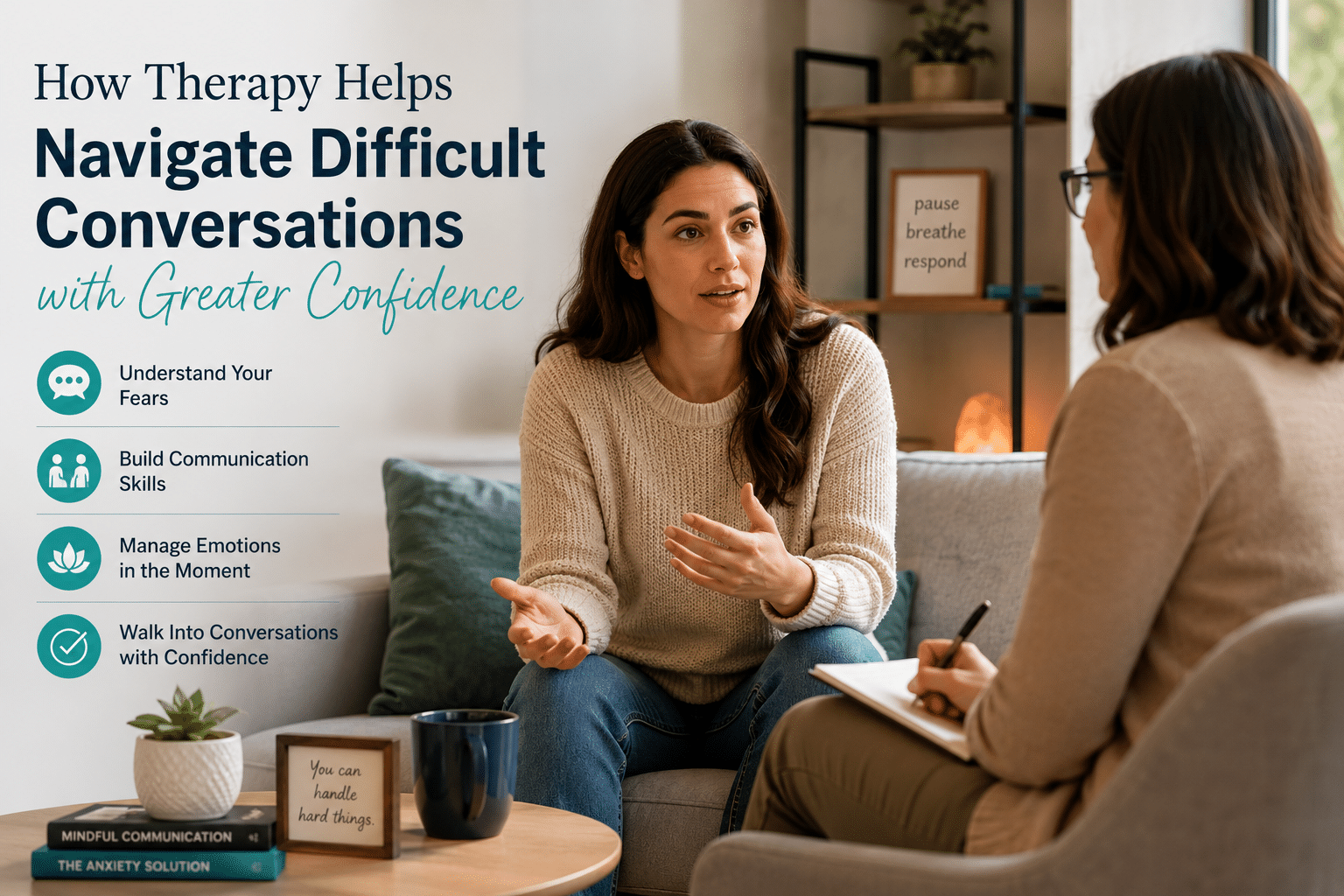
You know exactly what you need to say. Maybe it’s telling a partner you need more space, asking your boss for a deadline extension, or finally addressing months of tension with a sibling. And yet the conversation keeps slipping to “later.” That gap, knowing the words but not feeling able to say them, is where a lot of people get stuck.
Fear of how the other person will react, uncertainty about finding the right phrasing, and a body that seems to brace for impact before you’ve even opened your mouth can turn an ordinary conversation into something that feels genuinely threatening. The encouraging part is that this gap responds well to therapy.
Quick Answer Summary
Difficult conversations often trigger anxiety because they involve uncertainty, fear of conflict, and concern about how others may respond. Therapy helps patients build confidence by identifying anxious thought patterns, practicing communication skills, regulating emotions, and gradually facing challenging conversations in manageable steps. Whether through in-person or online therapy, patients can learn to communicate more clearly while reducing the fear that keeps them silent.¹²³
Key Takeaways
- Anxiety about difficult conversations often stems from fear of rejection, conflict, embarrassment, or uncertainty rather than the conversation itself.¹
- Cognitive Behavioral Therapy (CBT) helps patients identify and challenge anxious predictions while focusing on what they can control during conversations.²
- Role-playing, communication coaching, and gradual exposure help build confidence before addressing more emotionally difficult situations.²
- Learning emotional regulation techniques, including breathing exercises and mindfulness, can help patients stay calm and communicate more effectively under stress.
- Online therapy, including video and message-based counseling, has been shown to effectively reduce anxiety symptoms while improving access to care.³⁴
- Psychiatric treatment may complement therapy when anxiety becomes severe enough to interfere with work, relationships, or everyday functioning.
- Avoiding difficult conversations may provide temporary relief, but addressing concerns directly often strengthens communication, confidence, and long-term emotional well-being.¹⁵
Why Difficult Conversations Can Trigger Anxiety Symptoms
Long before a hard conversation happens, the mind tends to rehearse every possible way it could go wrong. That rehearsal alone is often enough to produce real anxiety symptoms.
The National Institute of Mental Health describes a familiar pattern:
- Worrying about an interaction days in advance
- Expecting the worst outcome
- A racing heart or trembling hands
- Mind going blank mid-sentence
- Speaking too softly or avoiding eye contact
- Replaying the whole thing afterward and cataloging every mistake
Avoidance can feel like relief in the moment, but the underlying worry doesn’t disappear if the conversation never happens.
It’s worth saying plainly that not every uncomfortable conversation points to an anxiety disorder. Ordinary stress is temporary. What’s different is when that discomfort persists, feels hard to control, and starts shaping decisions at work, at home, or in relationships.
How Therapy Helps You Identify and Reframe What You’re Afraid Of
“I just hate confrontation” is a common starting point in therapy, but it’s rarely the whole story. A therapist’s first job is often to get more specific about what’s being feared.
That vague dread usually breaks down into something concrete:
- “I think they’ll get angry”
- “I assume disagreement ends the relationship”
- “I’ll freeze and forget what I meant to say”
Cognitive behavioral therapy, or CBT, helps patients examine those predictions rather than treating them as facts. This isn’t about forcing positive thinking. It’s about testing whether a fear is complete, proportionate, and useful, then separating what you can control, your own words, tone, and timing, from what belongs entirely to the other person.
Confidence, in this context, doesn’t mean knowing things will go well. It means feeling capable of speaking clearly and handling whatever comes next.
Building Communication Skills and Practicing in Manageable Steps
Once the fear is named, the next step in therapy is usually practical: building the actual skills and reps needed to walk into the room.
That can look like drafting a one-sentence opening, role-playing a few likely responses, or rehearsing a direct request instead of a vague hint. A small pilot study of gynecologic cancer survivors found that a brief preparation intervention, pairing information with hands-on communication skills practice, measurably raised participants’ confidence in raising a sensitive topic with their care team, and more of them actually did it at their next visit.
Gradual exposure works the same way for everyday conversations. Instead of starting with the hardest discussion, group therapy settings or one-on-one sessions often start small: Voicing a minor preference, correcting a small misunderstanding, declining an unimportant request, so a person learns anxiety can rise and fall without forcing them to escape the situation.
Managing Emotions in the Moment and After
Even with preparation, strong emotion tends to show up mid-conversation anyway. Part of therapy is learning to work with that instead of trying to shut it off entirely.
That might mean noticing the first signs of escalation, slowing the breath, naming the emotion silently, or planning a pause before responding instead of reacting on impulse. Approaches like acceptance and commitment therapy lean into this directly: The goal isn’t an absence of fear, anger, or uncertainty, but keeping those feelings from making every decision.
Afterward, the work continues. Rather than treating an awkward pause or unfinished sentence as proof the conversation failed, patients are encouraged to ask what they communicated clearly, where they stayed grounded, and what they’d adjust next time, separating the facts of what happened from any assumptions about what the other person was thinking.
How Online Therapy and Psychiatric Treatment Expand Access to Support
For a lot of people, the biggest barrier to any of this isn’t motivation. It’s access. Online therapy and related digital options have changed that math considerably.
A 2025 randomized trial in JAMA Network Open found that a structured digital CBT program produced substantially greater reductions in generalized anxiety than psychoeducation alone, with the advantage still holding at 24 weeks. Separate research comparing therapist-led formats found that message-based psychotherapy and weekly video sessions produced nearly identical improvement, suggesting online counseling doesn’t have to mean live video to be effective. Some people genuinely do better organizing their thoughts in writing between sessions.
Access still varies considerably by location: A national secret-shopper survey of mental health facilities found that while most offered telehealth, the wait for a first appointment ranged widely. Nationally, SAMHSA data show tens of millions of American adults now receive mental health treatment through telehealth each year.
For some patients, a more comprehensive psychiatric treatment plan, combining psychotherapy with medication, may also be appropriate when anxiety is persistent or severe enough to interfere with daily functioning. Medication alone won’t teach assertiveness or conflict-resolution skills, but it can make it easier to fully participate in that work.
Reach Out to Zeam Health & Wellness for Support
Confidence doesn’t mean certainty. You can’t script how someone else will respond to hard news, a boundary, or an honest request, and therapy doesn’t promise to change that. What it can do is help you prepare, communicate with intention, tolerate the not-knowing, and recover steadily regardless of how the conversation goes.
At Zeam Health & Wellness, we work with patients through online therapy and in-person care to build exactly this kind of practical, lasting confidence. If a conversation has been weighing on you longer than it should, reach out to our team in Sacramento, Folsom, or Roseville to talk through what support could look like.
Therapy and Communication Confidence FAQs
How can therapy help me have difficult conversations?¹²
Therapy helps by identifying fears, teaching communication skills, practicing conversations through role-play, and building confidence so you can express yourself more effectively.
Why do difficult conversations cause anxiety?¹
Many people fear rejection, conflict, criticism, or disappointing others. These worries can trigger physical anxiety symptoms long before the conversation actually happens.
Can CBT improve communication skills?²
Yes. Cognitive Behavioral Therapy helps people recognize anxious thinking, replace unhelpful beliefs, and practice healthier ways of communicating in stressful situations.
Is online therapy effective for anxiety and communication challenges?³⁴
Yes. Research shows that online therapy—including both video and message-based formats—can effectively reduce anxiety while making mental health care more accessible.
When should I seek professional help for communication anxiety?¹⁶
If fear of difficult conversations consistently affects your relationships, work, or daily life, speaking with a mental health professional can help you develop practical coping and communication strategies.
Citations
- National Institute of Mental Health. Social Anxiety Disorder: More Than Just Shyness. https://www.nimh.nih.gov/health/publications/social-anxiety-disorder-more-than-just-shyness
- Stangier U, et al. Cognitive Behavioral Therapy for Social Anxiety Disorder. https://pmc.ncbi.nlm.nih.gov/articles/PMC10323044/
- JAMA Network Open. Digital Cognitive Behavioral Therapy for Generalized Anxiety Disorder. https://jamanetwork.com/journals/jamanetworkopen/fullarticle/2842818
- JAMA Network Open. Comparison of Message-Based Psychotherapy and Video Therapy. https://jamanetwork.com/journals/jamanetworkopen/fullarticle/2840708
- Communication Skills Interventions and Patient Confidence in Difficult Medical Conversations. https://pmc.ncbi.nlm.nih.gov/articles/PMC10837750/
- Substance Abuse and Mental Health Services Administration (SAMHSA). 2024 National Survey on Drug Use and Health Annual Report. https://www.samhsa.gov/data/sites/default/files/reports/rpt56287/2024-nsduh-annual-national-report.pdf