Depression can make a person feel trapped in patterns they cannot shift, even when they do everything their doctors recommend. Many people cycle through multiple antidepressants with little relief.
At some point, the question becomes less about willpower and more about biology. Why does the brain get stuck, and what does it take to help it move again?
Ketamine therapy works differently from standard medications, and recent research shows how it opens the door for new connections, fresh insights, and healthier thinking. Below is a grounded look at what scientists are finding and why it matters for anyone considering ketamine treatment, especially under medical supervision.
Why Traditional Antidepressants Fail Many People, and Where Ketamine Fits
Depression is common, but treatment-resistant depression is the real barrier. NIMH estimates nearly three million adults in the United States fall into this category, meaning they have tried at least two antidepressants without meaningful improvement. Traditional medications target serotonin, and they often help. Still, they act slowly. Some people wait weeks only to find their symptoms unchanged.
This becomes clearer when you look at how depression affects the brain long-term. Circuits responsible for mood regulation and decision-making can become rigid, almost locked into negative prediction loops. If serotonin-based medications cannot restore flexibility to those circuits, the person feels stuck in the same mental grooves.
Ketamine disrupts that pattern. Instead of focusing on serotonin, it works through glutamate, the brain’s primary excitatory neurotransmitter. This shift is one reason researchers consider ketamine infusion a breakthrough for people who have not responded to other treatments.
In several NIMH-supported studies, rapid changes appeared where nothing had shifted before. An early clinical trial found that about 71 percent of participants reported improvement after a single infusion. Newer trials continue to replicate that rapid response.
The Science Behind “New Thought Pathways”
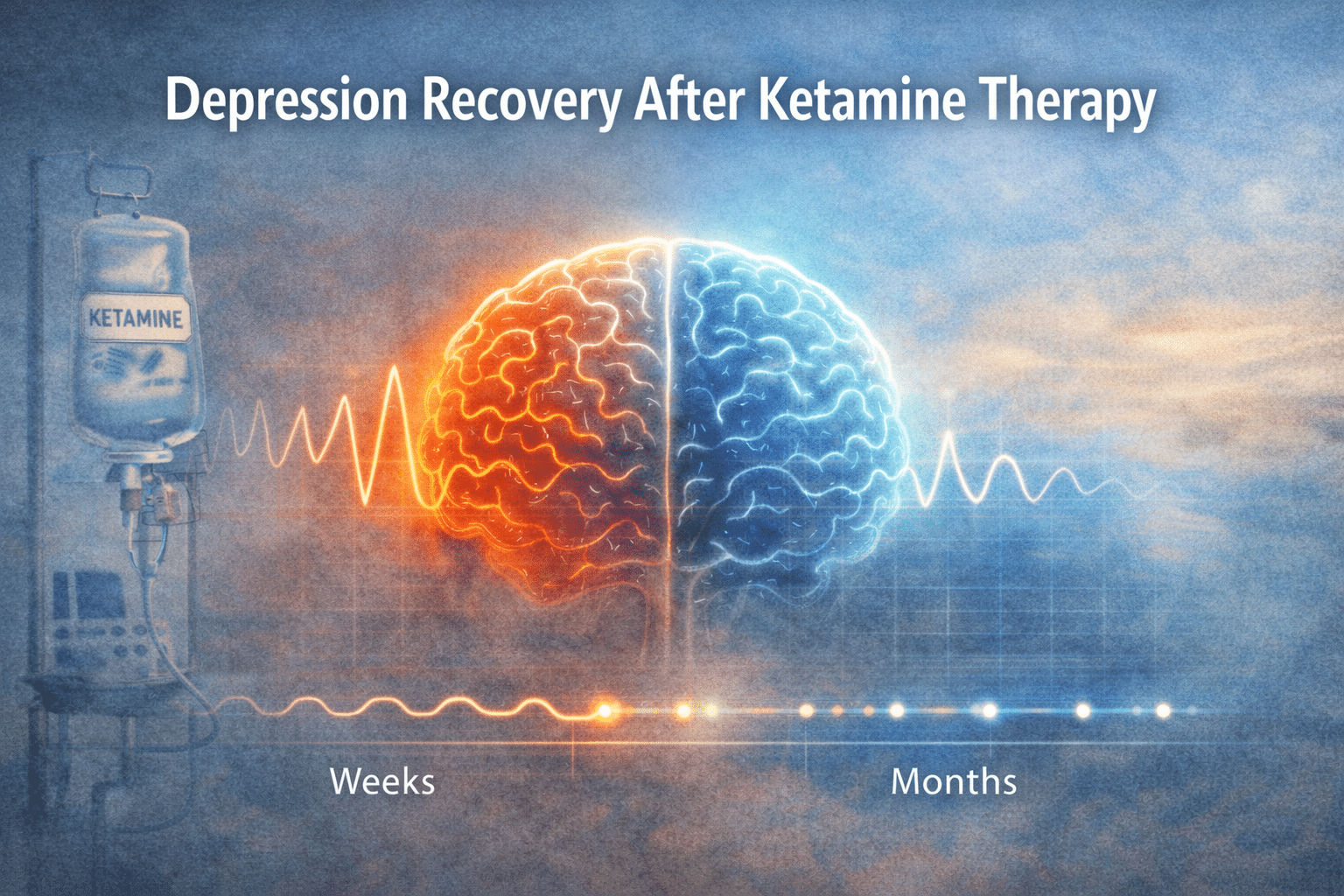
Understanding ketamine’s speed starts with what it does between neurons. During a ketamine infusion, NMDA receptors quiet down for a short period, which shifts the balance of signaling in mood circuits. That slight interruption pushes glutamate upward, AMPA receptors respond, and the brain releases BDNF, a protein known for helping neurons learn, adapt, and reconnect.
When BDNF rises, neurons behave differently. They strengthen weakened pathways and form new branches, creating what researchers often call a “plasticity window.” In that window, the brain becomes more open to new patterns instead of repeating the loops that depression reinforces.
A 2023 randomized controlled trial gives a clear look at this process in real numbers. Ninety-eight adults with treatment-resistant depression were scanned before treatment and again 24 hours after receiving ketamine or saline.
Those who received ketamine showed measurable microstructural changes in regions like the frontopolar cortex and amygdala, areas central to emotional processing. These changes weren’t subtle, as they tracked alongside symptom improvements on depression scales within the same 24-hour period.
How Ketamine Rewires Mood Circuits
Once ketamine opens that plasticity window, the next shift happens at the network level.
A 2024 imaging trial followed 152 adults with treatment-resistant depression and scanned their brains before and after treatment. The researchers saw something striking: Ketamine increased connectivity between prefrontal control regions and emotion-processing areas. Participants who began the study with the weakest connectivity, often the people feeling the heaviest symptoms, showed some of the largest gains. Their mood scores improved in the same direction as the connectivity increases, suggesting that ketamine’s impact on circuits is closely tied to how people start to feel afterward.
Another large phase-4 trial looked at esketamine as a stand-alone treatment. Participants receiving active medication showed a significant drop in depression scores within 24 hours. What stood out was the dose-response curve: Higher doses created larger improvements, and both were meaningfully better than the placebo group. That early change, often seen after the very first session, reinforces the idea that ketamine’s impact is less about slowly boosting chemicals and more about quickly reshaping networks responsible for emotional regulation.
These imaging findings support what many patients describe anecdotally: a sense that their thoughts loosen or that rigid patterns begin to shift. They are not imagining it. Their brains are behaving differently.
Why Therapy Matters After Ketamine
The plasticity window does not last forever. It opens quickly after a ketamine treatment and gradually settles as the brain rebalances itself. What someone does during that window shapes how those new pathways form.
A useful example comes from a behavioral study where people completed a short positive-association training exercise after ketamine. The antidepressant effect lasted longer for those who engaged in this structured practice compared to those who did nothing after their infusion. In some cases, the improvement extended for several months. It showed that ketamine creates the conditions for new learning, but the learning itself requires deliberate engagement.
This matters for anyone exploring ketamine therapists near them. Therapy, whether talk-based, skills-focused, or integrative, can help reinforce insights that emerge when the brain becomes more flexible. A person who feels stuck in negative narratives may suddenly have just enough space to question them. If a therapist helps them make meaning of that shift, it becomes easier to sustain.
Why Medically Supervised Ketamine Treatment Matters
Given ketamine’s potency, safety cannot be an afterthought. NIMH reminds patients and clinicians that dissociation, changes in blood pressure, and potential for misuse are real considerations. That said, these risks decrease significantly when treatment occurs in a structured medical environment.
This is where clinical programs make a meaningful difference. Screening ensures that someone is an appropriate candidate. Monitoring during the infusion protects their physical safety. Post-session support helps them process new thoughts or emotions that surface during the plasticity window. And the dosing plan can be adjusted over time based on how someone responds, something not possible in informal or unsupported settings.
People often search for ketamine therapists near them because the relationship between ketamine and therapy is becoming clearer in the research. The medication opens the mind, and the therapeutic process helps direct where it goes.
A New Pathway Forward for Brighter Thinking
At Zeam, we approach ketamine care with the same balance most people look for: solid science and steady support. We guide patients through each stage, from preparation to the session itself, and the work that follows, so the experience feels purposeful rather than rushed. If you are exploring ketamine therapy and want a team that walks with you, reach out. We can help you move toward clearer, healthier thought patterns.
Key Takeaways
- Ketamine helps people with treatment-resistant depression by working on glutamate pathways, not serotonin, offering relief for individuals who haven’t responded to multiple antidepressants.
- Research funded by NIMH shows ketamine rapidly increases brain plasticity, creating a temporary window where new neural connections and healthier thought patterns can form.
- BDNF release and AMPA receptor activation play a central role in ketamine’s ability to help the brain “relearn” emotional responses and interrupt depressive loops.
- Imaging studies show real structural and connectivity changes in brain regions tied to mood, including the prefrontal cortex and amygdala, often visible within 24 hours of treatment.
- The benefits last longer when paired with psychotherapy, because ketamine opens a plasticity window but therapy reinforces the healthier pathways formed during that period.
- Supervised medical settings remain essential, as clinical monitoring greatly reduces risks associated with dissociation, blood pressure changes, or potential misuse.
Citations
- NIMH – Ketamine’s mechanisms and rapid antidepressant research
https://www.nimh.nih.gov/news/science-updates/2023/cracking-the-ketamine-code - Early ketamine clinical trial demonstrating rapid antidepressant effects
https://pubmed.ncbi.nlm.nih.gov/16894061/ - Review of ketamine’s impact on neuroplasticity, glutamate signaling, and BDNF
https://pmc.ncbi.nlm.nih.gov/articles/PMC10170140/ - Updated research on ketamine-induced neural circuit changes and long-term outcomes
https://pmc.ncbi.nlm.nih.gov/articles/PMC10788398/ - 2023–2024 imaging studies showing microstructural and network-level brain changes after ketamine administration
https://jamanetwork.com/journals/jamapsychiatry/fullarticle/2836115 - Evidence for psychotherapy’s enhanced benefit when paired with ketamine’s plasticity window
https://pmc.ncbi.nlm.nih.gov/articles/PMC9722511/