
How Clinicians Help Patients Identify When Stress Has Become a Chronic Issue

Stress shows up when life asks more of you than usual, and most of the time it fades once the deadline passes or the crisis settles. The trouble starts when it does not fade. A pressure that felt temporary digs in, outlasts the thing that caused it, and quietly reshapes how you sleep, focus, and […]
Why Some Patients Wait Longer Than They Realize to Seek Mental Health Support
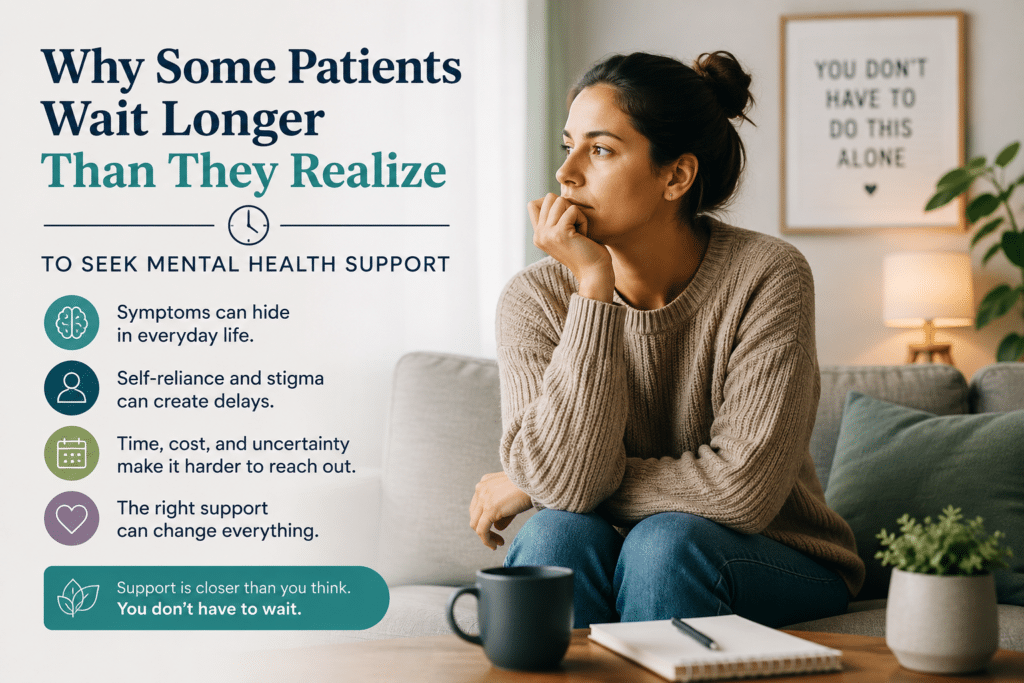
Most people do not wake up one morning and decide to put off mental health care. The change usually arrives slowly: Energy dips, sleep gets worse, patience runs thin, and motivation fades, and each shift feels small enough to explain away. Because the signs are so easy to misread, the gap between when symptoms start […]
Why Some Patients Struggle More Emotionally During Quiet or Unstructured Periods of the Day

A lot of people describe a version of the same experience. Work is fine, errands get done, and social plans go okay. But once the day quiets down, something shifts. Evenings feel heavy, and weekends feel harder than they should. Quiet time is not the problem. What those slower hours do is remove the noise […]
Why Some Patients Delay Psychiatric Treatment Longer Than They Realize

Many people live with anxiety, depression, or other mental health symptoms for months or years before reaching out for support. That gap is not about weakness or denial. It is often quieter than that: a gradual normalization of symptoms, a belief that things will settle on their own, or a genuine uncertainty about whether what […]
What to Expect During the Early Stages of Psychiatric Treatment for Chronic Symptoms

A lot of people go into their first few appointments expecting some kind of clarity to just arrive. A diagnosis, a plan, maybe a prescription. What actually happens is usually more gradual than that, and more conversational. Psychiatric treatment for chronic symptoms tends to start with a lot of questions before any answers are offered, […]
What Happens When Patients Need More Frequent Support Than Therapy Alone Provides

For a lot of people, weekly therapy is enough. It holds. But for some patients it doesn’t, and when that happens, the instinct is often to assume something went wrong. Usually, that’s not it. What’s happening is that the condition needs more than a single weekly hour can provide. According to SAMHSA’s 2024 National Survey […]
How Psychiatric Treatment Plans Evolve for Patients With Recurring Symptoms

Many people starting psychiatric treatment expect a clear path: try something, feel better, move on. That’s rarely how it works. Recurring symptoms, like depression that returns after months of stability or anxiety that creeps back during a hard stretch, are common enough that clinicians build flexibility into care plans from the start. That isn’t a […]
What Happens When Psychiatric Treatment Requires More Sessions Than Insurance Typically Covers

A lot of people start mental health care assuming insurance will handle it. Under the ACA, that’s mostly true, as behavioral health is a covered benefit. But there’s a gap between what a plan covers on paper and what gets approved once you’re several months in and someone at the insurer starts asking questions. This […]
How Teletherapy Fits Into Ongoing Psychiatric Treatment Plans for Chronic Conditions

Chronic psychiatric conditions don’t follow a set timeline. Depression, anxiety disorders, bipolar disorder, and PTSD are some of the conditions that often require consistent care over months or years, not a single acute episode with a clean ending. That reality is part of why teletherapy has become more than a convenient option for many patients. […]
How TMS Therapy Fits Into a Structured Psychiatric Treatment Plan

Most people don’t hear about TMS therapy until they’re already a few steps into psychiatric treatment. That’s how the system is designed: Certain tools come up only after earlier ones have been tried. TMS is one of those tools, and knowing where it typically enters the picture can make the whole process feel a lot […]