
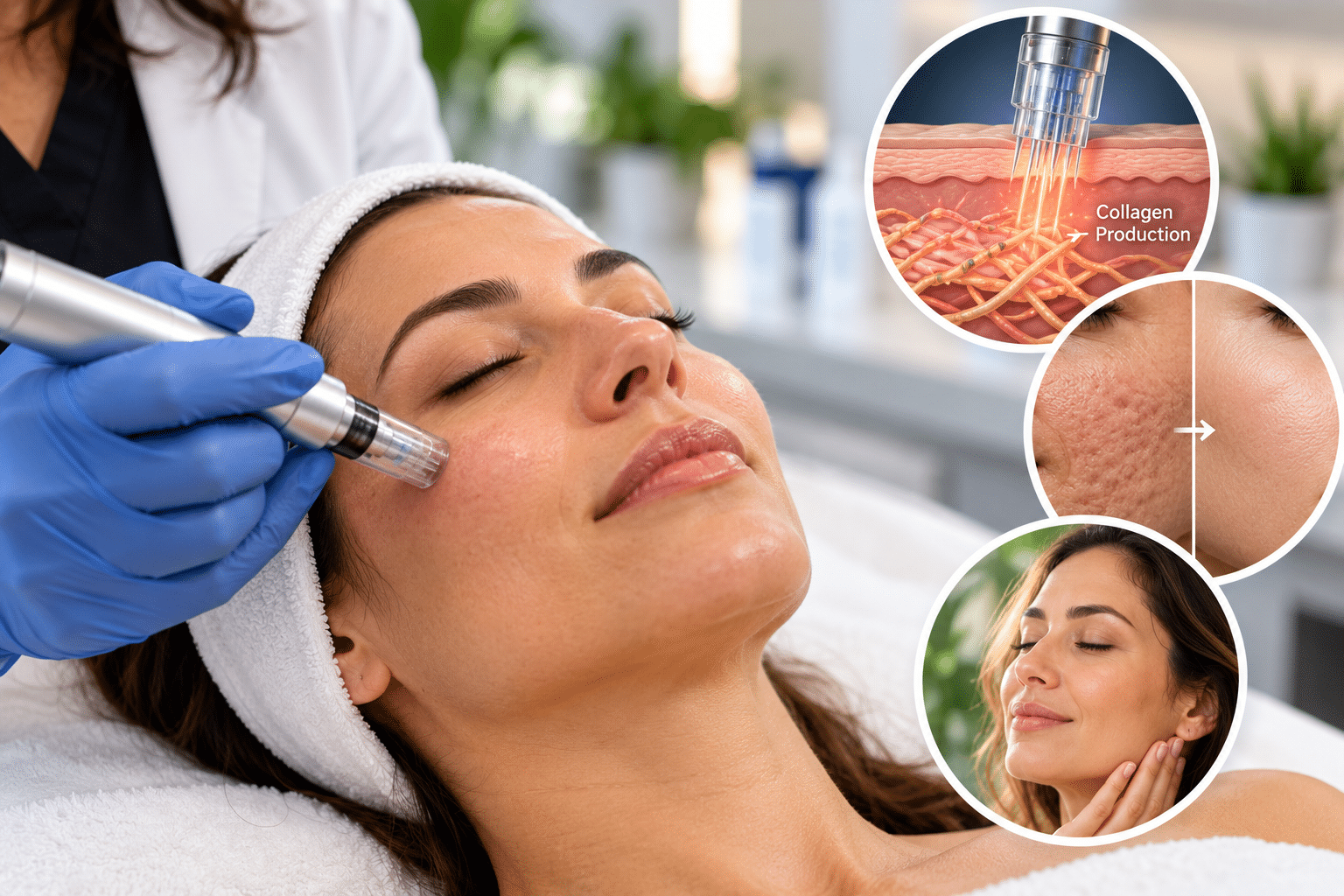
Microneedling gets brought up a lot when people talk about fading acne scars, softening fine lines, or smoothing uneven texture. The real change, though, happens beneath the surface in the days and weeks after an appointment, not during it.
The device uses very fine needles to make tiny, controlled punctures in the skin. Your skin treats those small injuries as something to repair, and that starts its normal healing response, including the production and reshuffling of collagen.
Below, we walk through how it works, the concerns it may help with, what a session looks like, how results build over time, and why no two plans are the same. One thing up front: Microneedling is not for everyone, and it comes with no guaranteed outcome.
Quick Answer Summary
Microneedling uses very fine needles to create controlled microscopic injuries in the skin, triggering a healing response that includes collagen production and remodeling.1,2 Over time, this process may help reduce the appearance of concerns such as atrophic acne scars, facial wrinkles, and uneven skin texture.2,3,4 Results develop gradually as the skin heals, and multiple treatments may be recommended depending on the concern, device, and individual response.2,4
Key Takeaways
- Microneedling creates controlled microscopic injuries that stimulate the skin’s natural repair process, including new collagen formation and remodeling.1,2
- Certain FDA-authorized microneedling devices are cleared for specific indications, including improving the appearance of facial acne scars and facial wrinkles.2
- Clinical research has found improvement in atrophic facial acne scars following microneedling treatment, although the goal is improvement rather than complete removal of scars.3
- Dermatologists may use microneedling to address concerns such as acne scars, uneven skin texture, enlarged-looking pores, wrinkles, and other signs of aging, but uses and device authorizations vary.2,4
- Temporary redness, swelling, dryness, discomfort, itching, peeling, pinpoint bleeding, or crusting can occur after treatment as the skin heals.2,4
- Results are gradual. Some improvement may become noticeable within weeks, while fuller results can take several months as collagen remodeling continues.4
- Microneedling is not appropriate for everyone, and factors such as active skin conditions, medical history, medications, healing tendencies, and treatment goals should be considered before treatment.2,4
How Does Microneedling Work?
When a trained provider does it, microneedling comes down to fine needles making controlled, microscopic injuries in the skin. It is not meant to buff or exfoliate the top layer. Those small wounds set a repair process in motion, one that builds and remodels collagen. That is where the name collagen induction therapy comes from.
Collagen is a big part of what gives skin its structure and firmness. As the skin closes those tiny channels, it lays down fresh collagen over the following weeks. There is human tissue research behind this. After a run of sessions, researchers have measured a rise in several collagen types, along with newly formed collagen and tropoelastin.
One thing to be clear about: Microneedling does not fill a wrinkle or wipe out a scar on the day of your visit. The change you can see shows up slowly, as the skin heals. Professional devices also vary in needle depth, speed, and design, which lets a provider dial the treatment in to the area and the concern at hand.
What Are the Benefits of Microneedling?
The microneedling benefits people talk about most trace back to that same healing-and-collagen response. Not every concern reacts the same way, and not every device is cleared for every use, so it is worth focusing on where the evidence is strongest. The FDA has authorized certain devices for specific uses, and those cleared uses cover softening the look of facial acne scars and facial wrinkles, depending on the device.
Acne Scars
Acne scarring is one of the better-established reasons people try it. Microneedling tends to be used for atrophic acne scars, the sunken kind that form when skin loses tissue or does not rebuild enough of it as a breakout heals.
In a randomized, placebo-controlled trial led by investigators at Northwestern University, the treated areas came out with less severe facial acne scarring than the untreated control areas. The goal is to make the scars less noticeable, not erase them completely.
Fine Lines, Wrinkles, and Skin Texture
That same collagen remodeling is the reason microneedling gets used to soften fine lines and smooth texture, rather than to plump or fill a line for a short stretch. The American Academy of Dermatology (AAD) points to a wider set of concerns dermatologists may take on this way. Its list runs from certain scars and uneven texture to enlarged-looking pores, stretch marks, and some signs of aging.
One caveat is worth holding onto. Just because a concern gets treated this way in a dermatology office does not mean every device has FDA authorization for it.
What Can You Expect During and After Microneedling?
A session of professional microneedling usually opens with a conversation, not the device. Your provider goes over your skin, medical history, medications, and what you want to change, then decides whether microneedling is a reasonable fit. A numbing cream usually goes on first to keep you comfortable.
From there, the device moves across the skin and makes tiny channels at a set depth. How deep it goes, and how strong the session feels, comes down to the concern, the spot being treated, the scar, and the particular device.
For a short while afterward, a few reactions are common:
- Redness
- Tightness or dryness
- Mild swelling or discomfort
- Itching or peeling
- Pinpoint bleeding or light crusting
The AAD likens that first feeling to a mild sunburn. Most of it eases within a few days to about a week. Plenty of people get back to their normal day quickly, though the skin still needs gentle care while it settles.
When Will You See Microneedling Results?
Microneedling results rarely show up overnight, because the skin needs time to heal and rebuild collagen. The AAD says some improvement can appear within a few weeks, while the fuller changes may take several months as collagen keeps remodeling.
Often, one session will not get you all the way there. The FDA points out that more than one procedure may be needed, and studies usually track a run of treatments spaced a few weeks apart. Even so, there is no magic number. The right course depends on your concern and the plan your provider maps out.
The effect is not permanent, either. Collagen keeps changing as we age, so results can fade, and some people come back for maintenance down the line.
Why Does Microneedling Treatment Vary From Person to Person?
No two plans look exactly alike, and results shift from one person to the next. A handful of things drive that:
- The concern being treated
- Scar type and severity
- Treatment depth and the device used
- The number and spacing of sessions
- Individual skin traits and healing response
- Aging and other ongoing effects on the skin
Planning is personal, too. Before recommending microneedling, a provider tends to weigh your skin concerns, medical history, medications, and how your skin usually heals. Some conditions, such as an active skin infection or a tendency toward keloid scarring, can change whether the treatment is a good idea or how it should be handled.
It is also worth knowing that radiofrequency microneedling is its own procedure, one that pairs the needling with radiofrequency energy. It works differently from standard microneedling, so the two are not interchangeable.
Understanding What Microneedling Can Do for Your Skin
The benefits of microneedling really come down to one idea: Controlled microscopic injuries prompt the skin to heal and lay down new collagen. Given time, that can soften acne scars, fine lines, wrinkles, and rough texture, though it happens gradually and the payoff differs from person to person. Whether it makes sense for you depends on your skin and your goals, which is exactly what a proper evaluation is for.
At Zeam Health & Wellness, microneedling is one of the aesthetic services we offer. We can look at your skin, hear what you want to change, and talk through whether microneedling is a fit for you. When you are ready, contact us to book a consultation, or reach our Roseville team at (916) 865-3670.
Citations
- El-Domyati M, Barakat M, Awad S, Medhat W, El-Fakahany H, Farag H. Microneedling Therapy for Atrophic Acne Scars: An Objective Evaluation. International Journal of Dermatology.
https://onlinelibrary.wiley.com/doi/10.1111/ijd.12761 - U.S. Food and Drug Administration. Microneedling Devices: Getting to the Point on Benefits, Risks and Safety.
https://www.fda.gov/medical-devices/aesthetic-cosmetic-devices/microneedling-devices - Alam M, Han S, Pongprutthipan M, et al. Efficacy of a Needling Device for the Treatment of Acne Scars: A Randomized Clinical Trial. JAMA Dermatology.
https://jamanetwork.com/journals/jamadermatology/fullarticle/1879091 - American Academy of Dermatology. Microneedling Can Fade Scars, Uneven Skin Tone, and More.
https://www.aad.org/public/cosmetic/scars-stretch-marks/microneedling-fade-scars/