
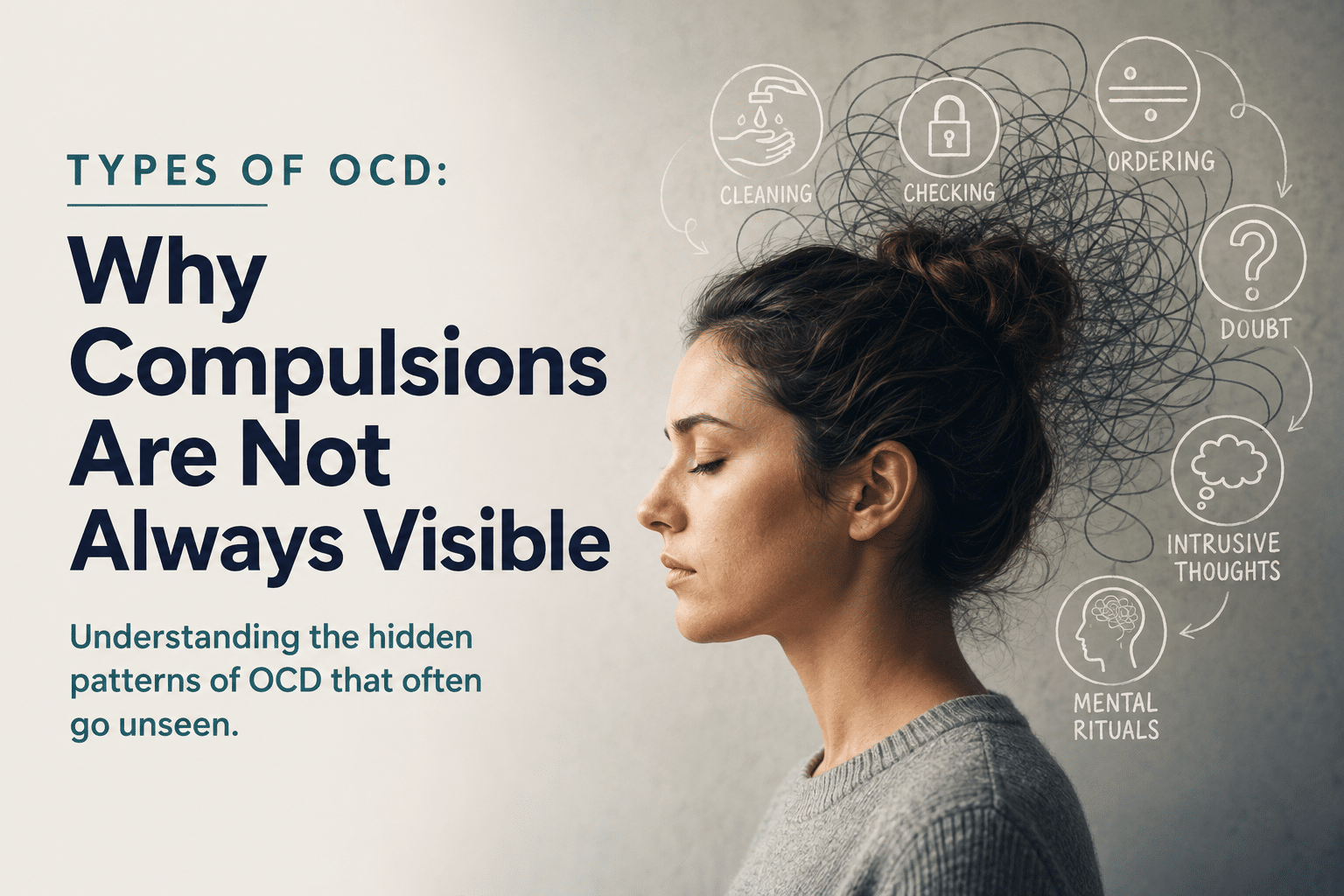
Most people picture obsessive-compulsive disorder (OCD) as washing hands too often or checking a lock repeatedly before leaving the house. That picture isn’t wrong, but it’s incomplete. A lot of what OCD looks like happens quietly, inside someone’s head, where nobody else can see it. Understanding the different types of OCD starts with recognizing that a compulsion doesn’t have to be something you can watch someone do.
Quick Answer Summary
OCD compulsions are not always visible. In addition to behaviors such as washing or checking, compulsions can include mental rituals like counting, praying, reviewing memories, neutralizing unwanted thoughts, seeking reassurance, or avoiding triggers.¹² Recognizing these less-visible patterns is important because treatment such as exposure and response prevention targets the ritual that follows an obsession, whether that ritual happens outwardly or entirely in the mind.¹⁸
Key Takeaways
- OCD can involve both visible behaviors and internal mental acts, including silent counting, praying, repeating words, and other rituals intended to reduce distress.¹²
- OCD symptoms commonly cluster around themes such as contamination, harm and checking, symmetry or “just right” experiences, and unacceptable thoughts, and people may experience more than one symptom dimension.³
- So-called “Pure O” does not necessarily mean an absence of compulsions; research has found that mental rituals and reassurance-seeking frequently accompany these primarily obsessional presentations.⁴
- Avoidance and family reassurance can become part of the OCD cycle, while ERP is designed to help people approach triggers or uncertainty without performing the usual compulsive response.⁶⁷⁸
Why OCD Doesn’t Always Look Like OCD
According to the NIMH, obsessive-compulsive disorder can involve obsessions, compulsions, or both. Obsessions are unwanted thoughts, urges, or images that cause real distress. Compulsions are the response: something a person does, either outwardly or in their own mind, to ease that distress or prevent a feared outcome.
That distinction matters because compulsions do not have to be visible. DSM-5 criteria include mental acts such as silent counting, praying, or repeating words internally, often according to rigid rules.
Compulsions rarely feel good; at most, they bring brief relief. They become clinically significant when they take up substantial time, cause significant distress, or interfere with work, school, relationships, or other parts of daily life.
The Types of OCD and Where They Hide
There isn’t a separate obsessive-compulsive disorder diagnosis for every subject someone obsesses over. A large clinical review found symptoms reliably cluster into four broad dimensions, and many people experience more than one at once.
Contamination and Cleaning
Compulsions may involve repeated washing, cleaning, or changing clothes. They can also take less visible forms, such as avoiding “contaminated” people or places, asking someone else to touch something first, or mentally reviewing a possible exposure.
Harm, Responsibility, and Checking
Doubt can send someone back to a lock or appliance they already checked. It may also lead to reviewing past events, asking the same question again, or avoiding decisions completely.
Symmetry, Ordering, and “Just Right” Feelings
For some people, a crooked object or unfinished feeling is hard to leave alone. They may adjust it, repeat what they just did, count quietly, or run through certain words until it eventually passes.
Unacceptable Thoughts and Mental Rituals
Compulsions may involve repeated confession, questioning, or avoiding certain situations. They can also happen internally through repeating a prayer or phrase, replacing an unwanted thought with a “safe” one, or analyzing its meaning over and over.
Labels like “relationship OCD” or “Pure O” can help someone describe their experience, but they aren’t formal diagnoses. Hoarding used to get grouped in here, too, but the DSM-5 now classifies it separately.
How Clinicians Tell an Obsession Apart From a Mental Compulsion
This is harder to spot, since both the obsession and the response can happen entirely inside someone’s mind.
Mental Rituals
Mental rituals serve the same purpose as visible compulsions. Someone might count silently, review an event, repeat a prayer to neutralize distress, or keep working through an argument until it feels settled.
In a study of so-called ‘Pure O,’ Williams and colleagues found that mental rituals and reassurance-seeking were closely associated with this presentation. The compulsions could be overlooked because they were not always visible.
Rumination vs. Obsession
An intrusive thought that arrives uninvited is part of the obsession, but deliberately debating it to reach certainty can become the compulsion. The line isn’t about where it happens. Rather, it’s about purpose, flexible thinking versus an urgent push to erase doubt.
Checking, Turned Inward
Checking works the same way. It’s often pictured as walking back to a locked door, but it can also mean re-reading a message for hidden meaning or checking whether a memory “feels” accurate.
According to Biria and colleagues, repeating the check can weaken confidence rather than settle it, pushing someone to check again. Clinicians consider not only the thought itself, but also what the person does next to reduce distress or find certainty.
Why Reassurance and Avoidance Keep the Cycle Running
Two common but easily missed obsessive-compulsive disorder patterns are avoiding triggers and repeatedly asking for reassurance.
Avoidance rarely looks like a ritual, since nothing repetitive happens on the surface. Someone might stop going somewhere, hand a task to a coworker, or put off a decision indefinitely. Previous estimates suggest that up to 59.7% of people with OCD engage in OCD-related avoidance.
Reassurance-seeking runs on the same engine: repeatedly asking a partner or family member to confirm nothing bad happened, a task was done correctly, or a thought doesn’t reveal something about who they are. Relief rarely lasts, so the question returns, sometimes reworded.
Loved ones often help by answering or adjusting routines around triggers. That support is understandable, but researchers call it family accommodation, and it can reinforce the cycle it was meant to ease.
These patterns get missed for practical reasons, too. Someone might feel anxious or indecisive without recognizing the ritual underneath it. Mental compulsions can look like ordinary problem-solving, and reassurance can sound like normal conversation. Many people also stay quiet about intrusive thoughts because they fear being judged, which is one reason why OCD can be difficult to diagnose.
How Treatment for OCD Reaches the Rituals You Can’t See
Treatment for OCD usually starts with a careful assessment of triggers, obsessions, visible and mental compulsions, avoidance, and reassurance-seeking. A Department of Defense evidence brief describes assessment, education, and collaborative treatment planning as the first stages of ERP.
Exposure and response prevention, or ERP, is a specialized form of cognitive behavioral therapy and one of the leading treatments for OCD. Exposure involves gradually approaching a situation, thought, or uncertainty that triggers distress. Response prevention focuses on not performing the ritual that normally follows. When the compulsion happens internally, treatment needs to address that mental ritual, too. The evidence for ERP is strong, although some people remain symptomatic, and treatment still needs to be tailored to the individual.
Medication is another established option, and SSRIs are used most often. They can take several weeks to begin helping. People whose symptoms have not improved with standard treatment can discuss additional options with their provider.
Naming What’s Been Invisible
Once you can name a mental ritual as a mental ritual, or reassurance-seeking as reassurance-seeking, it stops feeling vague and starts being something you can respond to differently. Recognizing the different types of OCD, especially the ones nobody else can see, is often the first step toward change. If any of this sounds familiar, Zeam is here to help you make sense of it. Reach out to our team about treatment for OCD built around your whole picture, not just what’s visible.
Citations
- National Institute of Mental Health. Obsessive-Compulsive Disorder: When Unwanted Thoughts or Repetitive Behaviors Take Over.
https://www.nimh.nih.gov/health/publications/obsessive-compulsive-disorder-when-unwanted-thoughts-or-repetitive-behaviors-take-over
NIMH describes OCD as involving obsessions, compulsions, or both and specifically includes compulsive counting, praying, and silently repeating words. It also identifies ERP as an effective OCD treatment. - Substance Abuse and Mental Health Services Administration. DSM-IV to DSM-5 Obsessive-Compulsive Disorder Comparison. NCBI Bookshelf.
https://www.ncbi.nlm.nih.gov/books/NBK519704/table/ch3.t13/
The DSM-5 criteria explicitly define compulsions as repetitive behaviors or mental acts, including praying, counting, and silently repeating words. - Williams MT, Mugno B, Franklin M, Faber S. Symptom Dimensions in Obsessive-Compulsive Disorder: Phenomenology and Treatment Outcomes with Exposure and Ritual Prevention. Psychopathology. 2013;46(6):365–376.
https://pmc.ncbi.nlm.nih.gov/articles/PMC3992249/ - Williams MT, Farris SG, Turkheimer E, et al. The Myth of the Pure Obsessional Type in Obsessive-Compulsive Disorder. Depression and Anxiety. 2011;28(6):495–500.
https://pmc.ncbi.nlm.nih.gov/articles/PMC3227121/
The study found that people commonly described as having primarily obsessional OCD frequently engage in mental rituals and reassurance-seeking. - Biria M, Banca P, Keser E, et al. Excessive Checking in Obsessive-Compulsive Disorder: Neurochemical Correlates Revealed by 7T Magnetic Resonance Spectroscopy. Biological Psychiatry Global Open Science. 2024;4(1):363–373.
https://pmc.ncbi.nlm.nih.gov/articles/PMC10829650/ - Wheaton MG, Gershkovich M, Gallagher T, Foa EB, Simpson HB. Behavioral Avoidance Predicts Treatment Outcome With Exposure and Response Prevention for Obsessive-Compulsive Disorder. Depression and Anxiety. 2018;35(3):256–263.
https://pmc.ncbi.nlm.nih.gov/articles/PMC6945296/
The paper notes previous estimates suggesting that as many as 59.7% of people with OCD engage in OCD-related avoidance. - Lebowitz ER, Panza KE, Bloch MH. Family Accommodation in Obsessive-Compulsive and Anxiety Disorders: A Five-Year Update. Expert Review of Neurotherapeutics. 2016;16(1):45–53.
https://pmc.ncbi.nlm.nih.gov/articles/PMC4895189/
Family accommodation describes changes relatives make to reduce or accommodate a loved one’s anxiety or OCD symptoms and can become intertwined with the disorder. - Defense Health Agency. Exposure and Response Prevention for Obsessive-Compulsive Disorder. 2024.
https://health.mil/Reference-Center/Publications/2024/03/29/Exposure-and-Response-Prevention-for-Obsessive-Compulsive-Disorder-2024-508