
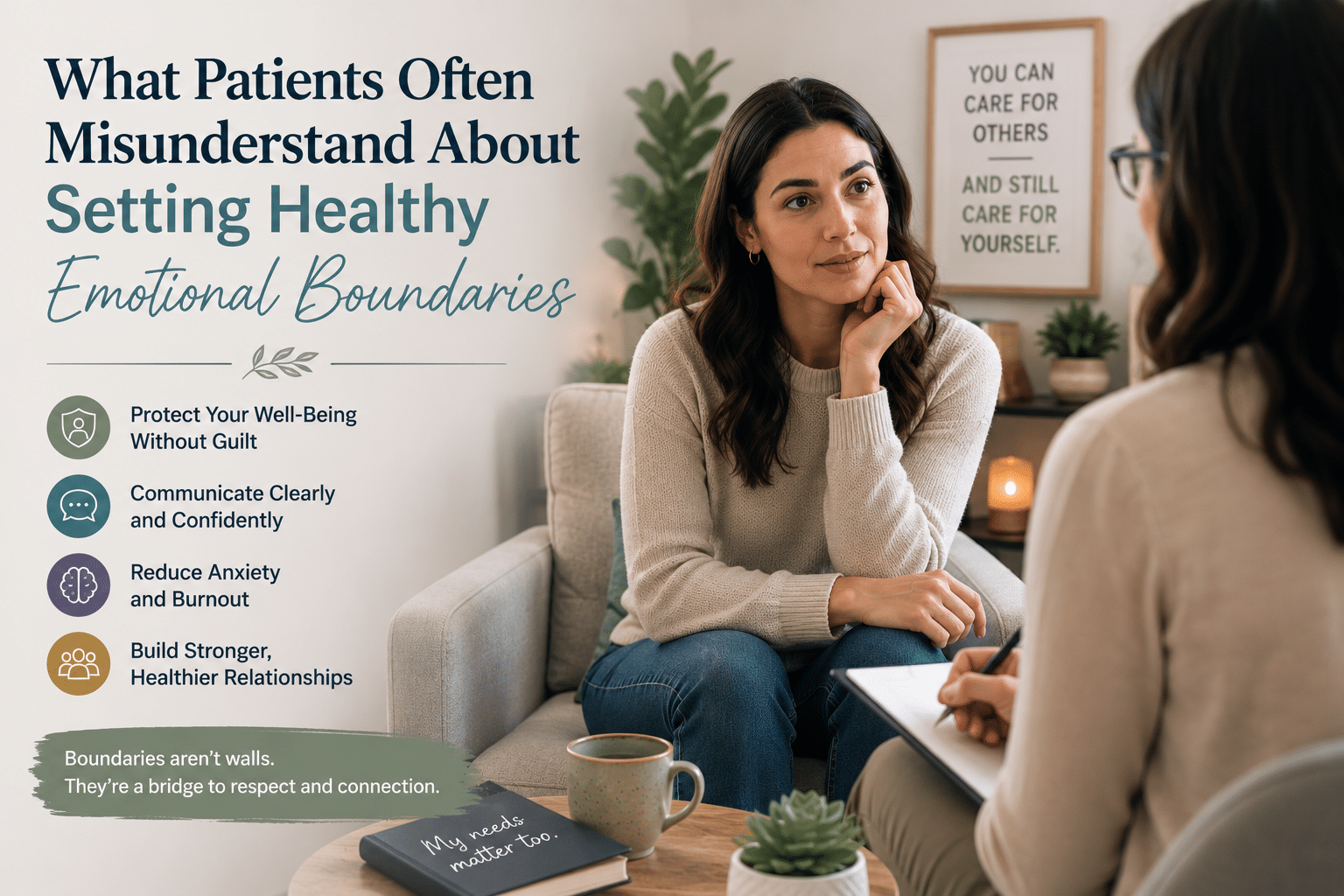
Most people don’t decide to drop a boundary. It happens in small moments: saying yes when you mean no, staying quiet when something feels unfair, picking up one more task because refusing feels harder than doing it. None of those moments looks significant alone. Strung together across a marriage, a job, or a friendship, they add up to a low-grade exhaustion that’s hard to name.
Patients often walk into a first session assuming the problem is something deeper than boundaries, maybe that they care too much, or aren’t built for relationships the way other people seem to be. What’s usually going on is narrower and more fixable: a handful of specific misunderstandings about what a boundary is.
Quick Answer Summary
Healthy emotional boundaries protect your well-being without damaging relationships. Therapy helps patients recognize unhealthy patterns like people-pleasing, over-accommodation, and guilt, while teaching practical communication skills that reduce burnout, improve relationships, and support long-term emotional health.¹²³
Key Takeaways
- Healthy boundaries allow you to care for others without sacrificing your own emotional or physical well-being.¹
- Feeling guilty after setting a boundary does not necessarily mean the boundary was wrong; anxiety and people-pleasing often make healthy limits feel uncomfortable.³
- Cognitive Behavioral Therapy (CBT) helps patients identify automatic patterns of over-accommodation, challenge unhelpful beliefs, and practice healthier communication.
- Chronic difficulty setting boundaries can contribute to stress, emotional exhaustion, burnout, anxiety, and strained relationships.¹⁵
- Caregiving can provide a strong sense of purpose while also creating significant emotional stress, making self-care and boundaries essential.¹
- Online therapy and in-person therapy both provide effective ways to develop healthier relationship patterns and communication skills.⁴⁶
- Learning to distinguish between requests, responsibilities, and personal limits helps improve emotional resilience and relationship satisfaction.²
Common Misconceptions About Healthy Boundaries
Three patterns come up more than any others, and untangling them tends to matter more than any communication script.
“Boundaries Mean I Don’t Care”
This misconception shows up first, and it shows up loudest in caregiving relationships. Loving someone and protecting your own capacity aren’t opposites, even though it can feel that way in the moment.
A survey of nearly 7,000 U.S. family caregivers, conducted by AARP and the National Alliance for Caregiving, found that a majority experienced moderate to high emotional stress, and nearly a quarter (23%) said caregiving made it hard to care for their own health. About half (51%), though, also said caregiving gave them a sense of purpose. Strain and meaning weren’t competing stories. They were the same story.
That’s worth sitting with if you’ve ever felt guilty for being tired around someone you love. The exhaustion doesn’t cancel out the love, and the love doesn’t obligate you to ignore the exhaustion. In therapy, untangling those two ideas is often one of the first steps.
“A Boundary Means Cutting Someone Off”
This one assumes boundaries are binary, either total access or total distance. The research on partner support tells a more useful story than that.
A study tracking daily stress and relationship quality among married U.S. adults found that people with more supportive partners had milder emotional reactions to a hard day. People with more straining partners, marked by excessive demands and criticism, carried that stress into the next day, too. A boundary is just a way of nudging that ratio back toward support.
A clinical trial backs this up from another angle. In a randomized trial for parents of highly dependent adult children, parents learned to stay warm and engaged while pulling back on constant accommodation: picking up every crisis call, smoothing over every consequence. Sixty percent no longer met the study’s criteria for “highly dependent” status afterward, with no comparable shift in the waitlist group. Staying close without overfunctioning is exactly the pattern a cognitive behavioral approach is built to work through.
“If It Feels Guilty or Anxious, the Boundary Must Be Wrong”
Plenty of people treat their own discomfort as a verdict on the boundary itself. The data on assertiveness suggests something different is usually happening.
A study of first- and second-year medical students measured assertiveness, meaning how comfortable someone is saying no, disagreeing, or speaking up when something is upsetting, alongside a standard anxiety screening tool. The two were strongly linked: Students with lower assertiveness scores tended to report more anxiety symptoms, and the relationship accounted for close to 40 percent of the variation in this small sample.
The study can’t say which one causes the other. What it does suggest is that the discomfort someone feels while setting a limit often has more to do with their anxiety than with whether the limit is reasonable. Fear of conflict, of disappointing someone, of an awkward silence after a hard text, these are common, very human reactions. They’re information about how anxious the moment feels, not proof that the request was unfair.
How Blurry Boundaries Quietly Lead to Burnout
Over-accommodation rarely announces itself. It builds slowly, through a long string of small yeses, until exhaustion starts to feel like a personality trait instead of a pattern.
When someone says yes to everything for long enough, it tends to surface less as one dramatic breaking point and more as chronic tension: trouble sleeping, irritability, dread about the next phone call or favor request. That pattern can resemble generalized anxiety, because in a real sense it functions like it: a nervous system that’s stayed on alert too long with no real recovery in between.
It’s worth being honest about the limits of this, though. A CDC report on healthcare workers, surveyed during and after the pandemic, found that workplace stressors like understaffing and heavy workloads predicted higher odds of anxiety, depression, and burnout, regardless of how supportive a manager was. Support helped, but it didn’t erase the effect of structural overload.
Boundaries are a real, useful skill. They are not a substitute for adequate staffing, fair workloads, or a system asking too much of one person.
How Therapy and Psychiatric Treatment Support Boundary-Setting
This is also where the format of care matters less than people assume. Evidence-based treatment doesn’t require sitting across from someone in an office.
A therapist working on boundaries with a patient is usually doing a fairly specific set of things:
- Helping them tell a request apart from an obligation
- Naming patterns of automatic agreement or over-explaining
- Rehearsing what to say once guilt shows up afterward
None of that requires being in the same room. A study comparing telehealth and in-person cognitive behavioral therapy for youth anxiety disorders found close to identical response rates between formats. Researchers concluded that online therapy met their criteria for being just as effective, not a smaller version of real care.
Let Us Help You Build Healthier Boundaries
None of this means you must sort out your boundaries alone, or that asking for help means something is wrong with you. At Zeam Health & Wellness, we work with patients on exactly this kind of pattern: identifying where over-accommodation has crept in, sorting out which discomfort is useful information versus old fear, and practicing the actual words for a hard conversation.
Some patients start with psychiatric treatment to get a handle on underlying anxiety first. Others come straight to talk therapy, in person or through online counseling, to work through the relationship patterns themselves. We’ll help you figure out which path fits where you’re starting from.
If any of this sounds familiar, reach out to our team in Sacramento, Folsom, or Roseville, and we’ll find a time to talk it through.
Emotional Boundaries and Therapy/Psychiatry FAQs
What are healthy emotional boundaries?¹²
Healthy emotional boundaries are limits that protect your mental and emotional well-being while allowing you to maintain caring, respectful relationships.
Why do I feel guilty when I set boundaries?³
Many people experience guilt because they fear disappointing others or creating conflict. Therapy can help distinguish healthy concern from anxiety-driven guilt.
Can therapy help me stop people-pleasing?²³
Yes. Therapy helps identify people-pleasing patterns, build assertiveness, and practice healthier communication that supports both your well-being and your relationships.
Can setting better boundaries reduce burnout?¹⁵
Yes. Healthy boundaries help prevent emotional exhaustion by reducing chronic overcommitment, improving stress management, and allowing time for rest and self-care.
Is online therapy effective for learning boundary-setting skills?⁴⁶
Yes. Research shows that online therapy can be just as effective as in-person therapy for many anxiety-related concerns, including developing healthier communication and relationship skills.
Citations
- AARP & National Alliance for Caregiving. Caregiving in the U.S. 2025. https://www.aarp.org/content/dam/aarp/ppi/topics/ltss/family-caregiving/caregiving-in-us-2025.doi.10.26419-2fppi.00373.001.pdf
- Randomized Trial of Parent Accommodation and Boundary-Setting Interventions. https://pmc.ncbi.nlm.nih.gov/articles/PMC12439855/
- Assertiveness and Anxiety Among Medical Students. https://journals.sagepub.com/doi/10.1177/21676968241252851
- Telehealth Delivery of Mental Health Care and Patient Outcomes. https://formative.jmir.org/2025/1/e73394
- CDC. Workplace Stress, Burnout, Anxiety, and Depression Among Health Care Workers. https://www.cdc.gov/mmwr/volumes/74/wr/mm7402a1.htm
- A Comparison of Telehealth and In-Person Therapy for Youth Anxiety Disorders. https://connectwithcare.org/wp-content/uploads/2025/04/A-Comparison-of-Telehealth-and-In-Person-Therapy-for-Youth-Anxiety-Disorders.pdf
Citations
- AARP & National Alliance for Caregiving. Caregiving in the U.S. 2025. https://www.aarp.org/content/dam/aarp/ppi/topics/ltss/family-caregiving/caregiving-in-us-2025.doi.10.26419-2fppi.00373.001.pdf
- Randomized Trial of Parent Accommodation and Boundary-Setting Interventions. https://pmc.ncbi.nlm.nih.gov/articles/PMC12439855/
- Assertiveness and Anxiety Among Medical Students. https://journals.sagepub.com/doi/10.1177/21676968241252851
- Telehealth Delivery of Mental Health Care and Patient Outcomes. https://formative.jmir.org/2025/1/e73394
- CDC. Workplace Stress, Burnout, Anxiety, and Depression Among Health Care Workers. https://www.cdc.gov/mmwr/volumes/74/wr/mm7402a1.htm
- A Comparison of Telehealth and In-Person Therapy for Youth Anxiety Disorders. https://connectwithcare.org/wp-content/uploads/2025/04/A-Comparison-of-Telehealth-and-In-Person-Therapy-for-Youth-Anxiety-Disorders.pdf