
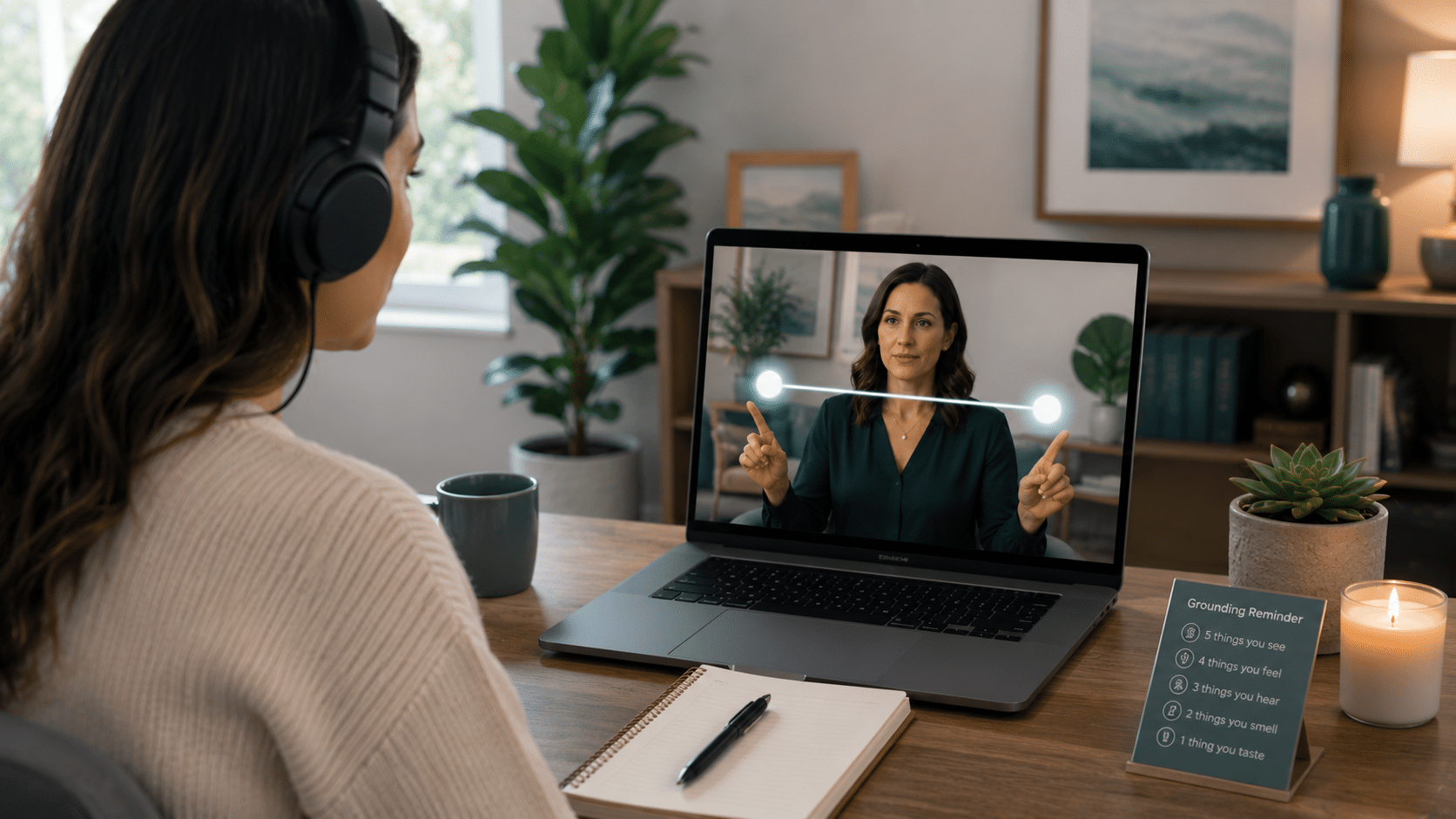
Most people picture EMDR as something physical. You sit across from a therapist, follow their hand with your eyes, and let the back-and-forth motion do its work. So, when the whole thing moves to a video call, a fair question comes up: Does it still count?
That doubt makes sense, but it rests on a misunderstanding of what the therapy actually is. The delivery method shifts when the work moves to a screen. The larger process behind it stays put.
This article walks through what EMDR online keeps intact, what it adapts, and how to tell whether a virtual version fits you.
Quick Answer Summary
Online EMDR follows the same eight-phase treatment model used during in-person therapy, with adaptations for secure video sessions. Therapists use virtual eye movement tools, alternating sounds, or guided tapping while maintaining structured assessment, preparation, trauma processing, and closure. Research suggests virtual EMDR can effectively reduce PTSD symptoms for many people when delivered by a trained clinician in an appropriate setting.
Key Takeaways
- Online EMDR follows the same eight-phase treatment process as in-person EMDR, including assessment, preparation, processing, and follow-up.¹²
- Virtual sessions use adapted forms of bilateral stimulation such as on-screen visual cues, alternating audio, or guided self-tapping.²³
- A private environment, reliable internet connection, and an established emergency plan help support safe and effective telehealth sessions.³⁴
- Research continues to support telehealth EMDR as an effective treatment option for many individuals with PTSD, although some patients may benefit from in-person or hybrid care depending on their needs.²⁵
- Choosing between online and in-person EMDR should be based on clinical needs, safety, comfort, and access to specialized trauma therapists.
What EMDR Actually Is (Not Just Eye Movements)
Before comparing formats, let’s look at what happens in any session, in person or otherwise. The eye movements get the attention, but they are one piece of a much bigger method.
EMDR stands for Eye Movement Desensitization and Reprocessing. In a session, you briefly bring a distressing memory to mind while paying attention to a back-and-forth signal, such as moving your eyes, alternating tones, or gentle taps.
Structured EMDR therapy follows eight phases:
- History taking
- Preparation
- Assessment
- Desensitization
- Installation
- Body scan
- Closure
- Re-evaluation
That structure matters, because the stimulation is only useful inside it. The rest of the work, the assessment and pacing and closing, is what makes it therapy rather than an exercise.
It also helps to be honest about the mechanism. The stimulation gives your brain an extra task while a memory is active, and researchers are still studying exactly why that seems to lower distress.
What Stays the Same When EMDR Goes Online
The reassuring part is that almost everything that defines the therapy carries over to a video session without change. The eight-phase framework stays intact.
Trauma processing does not begin in the first appointment; your therapist starts with history and preparation, the same as they would in an office. You still build grounding and regulation skills before anyone targets a hard memory. You and your therapist still choose targets together and track how disturbing a memory feels using simple 0-to-10 ratings. Processing still happens in short sets, with pauses to check in on what you notice. You still do not have to narrate the event in detail, and the session still ends with a deliberate closing step rather than a hard stop.
Most of all, the relationship stays central. This is not a self-guided app. A trained clinician is still watching, pacing, and responding the whole way through.
What Changes in a Virtual Session
The changes are real, but they sit around the edges of the process rather than at its core. Most of them come down to logistics and attention.
The biggest shift is how the back-and-forth stimulation reaches you. Instead of following a therapist’s hand, you might track a moving dot on your screen, listen to tones that alternate between your ears, or tap your own shoulders while the therapist guides you.
The VA recognizes self-tapping, headphones, and visual apps as valid remote methods, and the format can be matched to what feels comfortable for you. Your room and your screen also become part of the setup, which they never were in a clinic. Because a camera catches less than a therapist sitting a few feet away, expect more frequent verbal check-ins and some care about camera placement.
A dropped connection turns into a clinical issue, too, so you and your clinician agree in advance on how to reconnect and how to stay grounded if the video freezes mid-memory. One quieter change: After an office visit, the drive home gives you time to settle, but closing a laptop drops you straight back into daily life, so EMDRIA suggests leaving a buffer afterward.
How Clinicians Keep Online EMDR Grounded + What to Set Up
Good virtual care is built on preparation from both sides. You handle the environment while your clinician handles the safeguards.
On your end, a short checklist covers most of it:
- A private space where you can react without being overheard
- A stable device with a decent-sized screen rather than a small phone
- Reliable internet
Headphones if you are using sound - A charged backup phone
- A camera near eye level
Your therapist also confirms where you are physically located, which matters for both licensing and emergency response.
On their end, clinicians assess whether you are ready rather than assuming it, build regulation skills before harder targets, keep watch on your distress throughout, and protect time for closure. Grounding leans on what is around you, like feeling your feet on the floor or naming what you see, and it gets practiced before it is ever needed.
Does Online EMDR Actually Work? (Proof + Honest Limits)
EMDR has a solid track record for PTSD treatment overall. On direct comparison, a 2025 VA study followed 279 veterans, with about half treated in person and half through teletherapy. Both groups improved on PTSD and depression. The in-person group saw somewhat larger average symptom reduction, but the two groups did not differ meaningfully in how many people finished treatment or reached real improvement. This was a look back at existing charts rather than a controlled trial, so it supports virtual care without proving the formats are identical.
In practice, EMDR online tends to fit well when local specialists are scarce, privacy is solid, and you can stay grounded when distress rises. In-person or hybrid care may serve you better when you lack private space, your connection keeps cutting out, or closer monitoring is needed for safety.
Finding Your Footing, On Screen or In the Room
EMDR can take place in an office or through a secure video session. The setting may change, but the core work remains the same: thoughtful preparation, guided processing, regular check-ins, and time to feel settled before the session ends. You and your therapist can also revisit the format if your needs change.
If you are considering EMDR, contact Zeam to talk through your options. You can meet with us in person or through online therapy, whichever feels like the better fit.
Citations
- American Psychological Association. The Eight Phases of EMDR Therapy. https://www.apa.org/topics/psychotherapy/emdr-phases
- U.S. Department of Veterans Affairs. Eye Movement Desensitization and Reprocessing (EMDR) for PTSD. https://www.ptsd.va.gov/professional/treat/txessentials/emdr_pro.asp
- EMDR International Association (EMDRIA). Virtual EMDR Therapy Guidelines Report. https://www.emdria.org/resource/virtualemdrguidelinesreport/
- U.S. Department of Health & Human Services. Creating a Telehealth Emergency Plan. https://telehealth.hhs.gov/providers/best-practice-guides/telehealth-for-behavioral-health/preparing-patients-for-telebehavioral-health/creating-a-telehealth-emergency-plan
- Teletherapy versus in-person EMDR for PTSD: A retrospective study of veteran outcomes. https://pubmed.ncbi.nlm.nih.gov/40424141/